

We Were Skeptical Too. Then the Itinerary Came Back and We Stopped Exchanging That Look.
Written By: Joanie Ogg, CTC, MCC – Travel Professional NEWS
How travel agents can harness artificial intelligence to build stunning itineraries, impress clients, and maybe, just maybe, reclaim their weekends.

Let me confess something. When a publicist first pitched us on “AI-generated” travel itineraries, Tom and I exchanged the kind of look that only people who have spent almost sixty years in the travel industry can exchange. It was a look that said, simultaneously, “here we go again” and “we have seen every technology revolution this industry has produced, and most of them turned out to be considerably less revolutionary than advertised.”
We survived the advent of commission-inclusive pricing. We survived the internet, which was supposed to eliminate travel agents entirely. We survived the OTA revolution, the mobile booking revolution, and roughly forty-seven other revolutions that were definitively going to change everything forever. We were, in a word, skeptical.
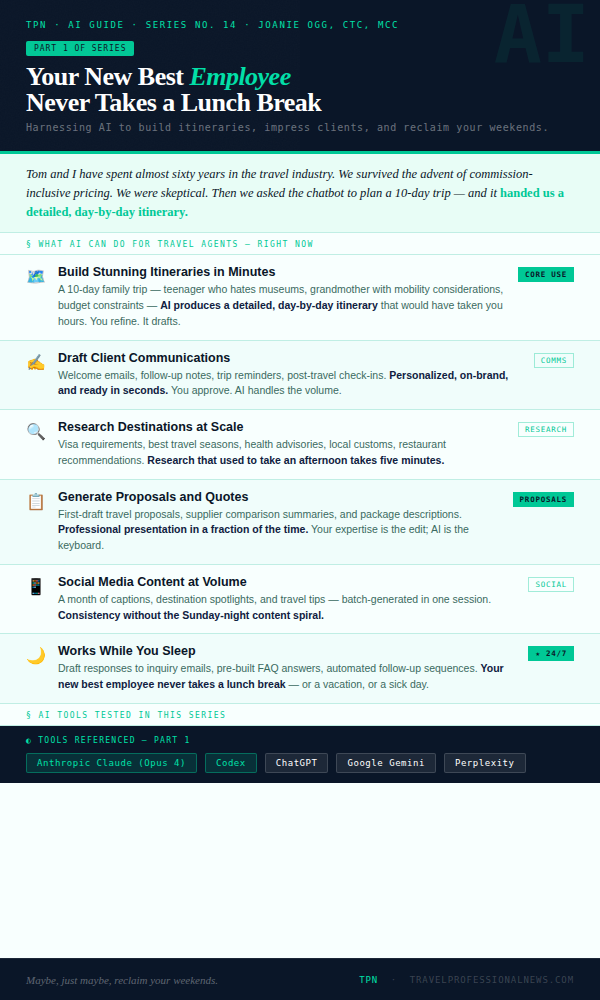
Then we asked the chatbot to plan a 10-day trip for a family of four – a teenager who hates museums, a grandmother with mobility considerations, parents with a budget and mixed interests – and it handed us a detailed, day-by-day itinerary that addressed every constraint, included specific restaurant recommendations, accounted for travel time between attractions, and suggested a rhythm of activities that actually made sense for the people involved.
We stopped exchanging that look.
What We Tested – and What Impressed Us
Over the past several months, we have been systematically testing the major AI platforms available to travel professionals – including Anthropic Claude (Opus 4), Codex, ChatGPT, and others – across the full range of tasks a home-based travel advisor performs. The results have been, to put it plainly, more useful than we expected and more honest about limitations than we feared.
The family itinerary test was our first. We gave Claude Opus 4 the brief exactly as a real client might present it – complicated, slightly contradictory, and full of the kind of soft constraints (“the teenager gets bored easily,” “grandma can’t do more than three hours on her feet”) that experienced advisors manage instinctively. The result was a detailed, day-by-day itinerary that we would not have been embarrassed to present to a client as a first draft. It needed editing. It needed the kind of supplier knowledge and personal experience that only comes from decades in the industry. But it was a remarkably solid starting point that would have taken a new advisor several hours to produce independently.
What AI Does Well – and What It Still Cannot Do
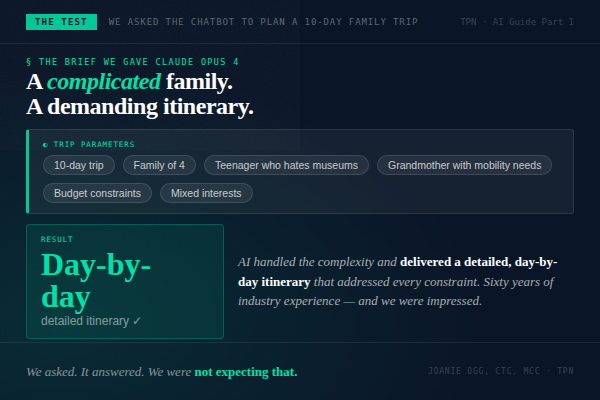
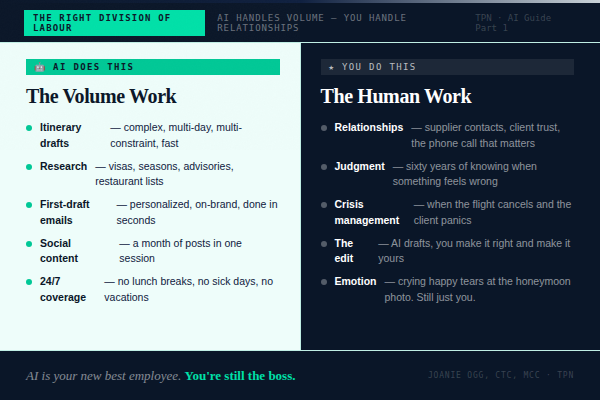
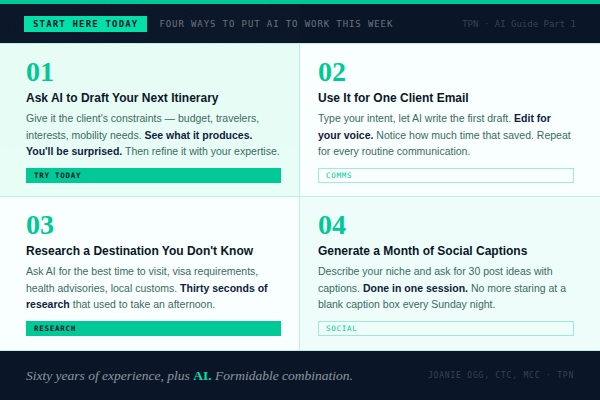
Here is what we have found AI genuinely, reliably useful for in a travel advisory context: building first-draft itineraries, drafting client communications, researching destination logistics (visas, seasons, health advisories), generating social media content, and producing professional proposals at a speed that would otherwise require either additional staff or working weekends. In each of these areas, AI functions like a highly efficient, always-available assistant who never takes a lunch break, never calls in sick, and is never in a bad mood because of something that happened on the way to work.
What AI cannot do – and this is important, because it is where your professional value lives – is build genuine human relationships. It cannot call the supplier representative you have known for fifteen years and explain a client situation in a way that gets it resolved. It cannot sit across from a client and read the hesitation in their voice when they say “budget” and understand that they mean something different. It cannot be held accountable, in the way that you are held accountable, when something goes wrong at 11 p.m. in a foreign city. And it cannot, yet, replace the judgment that comes from sixty years of combined industry experience – the knowledge of when something feels wrong about a booking before you can articulate exactly why.
How to Start – This Week, Not Someday
The single biggest mistake travel advisors make with AI is treating it as something to explore later, when things slow down, when there’s time to learn a new tool properly. There is never time. You start now, with small experiments, and you build from there.
This week: take one real client brief and give it to an AI tool. Give it the full complexity – the competing interests, the budget constraints, the family dynamics. See what comes back. You will almost certainly be surprised. Then spend thirty minutes editing the result with your own knowledge and experience, and notice how much time you saved compared to building from scratch.
That’s the workflow: AI drafts, you improve. AI handles the volume, you handle the relationships and the judgment. Your new best employee never takes a vacation. You still do, and now perhaps you can actually take one.
Coming in Part 2
In Part 2 of this series, we go deeper into specific prompting strategies that get better results from AI tools, the particular platforms we found most useful for travel advisory work, and how to train AI on your own voice and brand so that what it produces actually sounds like you. Stay tuned.
To explore more resources for travel professionals navigating the AI revolution, visit Travel Professional NEWS.