

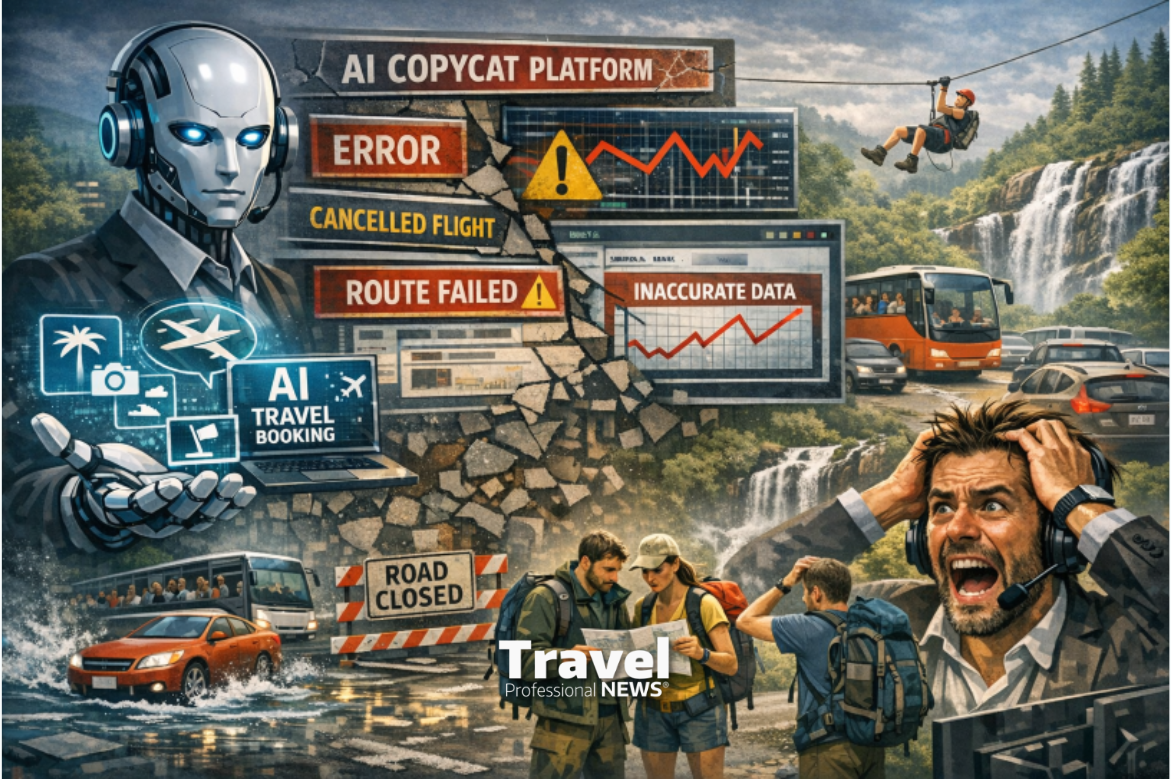
The company says generative AI is enabling a wave of imitation systems that look slick but fail when weather, cancellations, or operational complexity hit
NEW YORK, NY, Apr. 14, 2026 – TripWorks today warned that a surge of AI‑generated “instant booking platforms” is putting tour and activity operators around the world at risk, as a wave of new research reveals widespread accuracy failures and operational breakdowns across the travel tech sector.

The company says the industry is entering an “AI copycat bubble” – a moment where generative AI can produce a polished interfaces that mimic established platforms in minutes, but lack the operational maturity required to run high‑volume, real‑world experiences. This mirrors new analysis from several major sources. For example, Harvard Business Review found that generative AI is destabilizing online travel platforms by enabling fast‑moving entrants to ship products that lack the resilience of established systems[i].
At the same time, two more major travel industry studies found that 91% of travelers now use AI for travel planning[ii], yet 91% also question their accuracy[iii]. A different survey last month also revealed that only 8% of travelers say AI answers alone are sufficient, with 51% clicking through to source websites to check AI‑generated results[iv].
Real‑world failures are already visible: AI travel planners have misrouted travelers – including a documented case in Paris where ChatGPT recommended a route that ignored road closures – and other industries have seen mispriced airline tickets, mistranslations that triggered emergency responses, and outages linked to AI‑assisted code changes.
TripWorks CEO Aaron Fessler says these failures are a warning sign for operators evaluating new booking systems:
“Generative AI can build a beautiful demo, but it can’t build operational maturity. We’re seeing a wave of copycat platforms assembled by AI. They look slick until real‑world complexity hits – weather, cancellations, group logistics, refunds, OTA quirks. A booking platform needs to be treated as infrastructure, rather than just a pretty website.”
“Many of these AI‑assembled platforms share the same weaknesses: they lack a true operations engine, rely on untested AI‑generated logic, and confuse interface with infrastructure. The result is systems that perform well in a demo but fail under pressure.
“A demo is not a platform. Operators deserve systems proven under real‑world load – not something spun up by AI over a weekend.”
“Operators must demand transparency from vendors, including evidence of real‑world booking volume, reliability under peak load, and safeguards against AI‑generated errors.
“AI is a powerful accelerator, but it’s not a substitute for engineering, testing, or operational experience. The companies that survive this AI Booking Bubble will be the ones that combine AI with real infrastructure.”