

Nobody Fills Out a Form for Information They Can Get From a Chatbot. Here Is What They Will Fill It Out For.
Written By: Tom Ogg, Co-Founder and Co-Owner – Travel Professional NEWS

Any traveler can now get a free destination guide from a chatbot in seconds. The advisor’s ebook still builds email lists, but only if it delivers what AI can’t, and only if the title earns the click.
I’ll start with a confession that sounds odd coming from someone who has spent years telling travel advisors to build their email lists with ebooks: I almost never fill out the form. When a website wants my name and email before it shows me anything, I usually hit the back button and keep searching. I suspect you do the same.
That reluctance is far stronger in 2026. A traveler who wants a Venice guide no longer has to trade anything for it. They type a question into ChatGPT, Gemini, Claude or the AI summary at the top of a Google search, and a tidy itinerary appears in seconds. It’s free, and nobody will send them a follow up email.
So here is the uncomfortable question every advisor should ask before writing another lead magnet: why would anyone hand over an email address for your 20 page PDF?
The answer is the reason this article exists. The ebook still works. The generic ebook doesn’t.
Free Information Is Now Free; Experience Is Not
When I first wrote about ebooks for travel advisors, your competition was other websites, guidebooks and the occasional supplier brochure. Now your competition is software that has read most of those websites and can summarize them on demand.
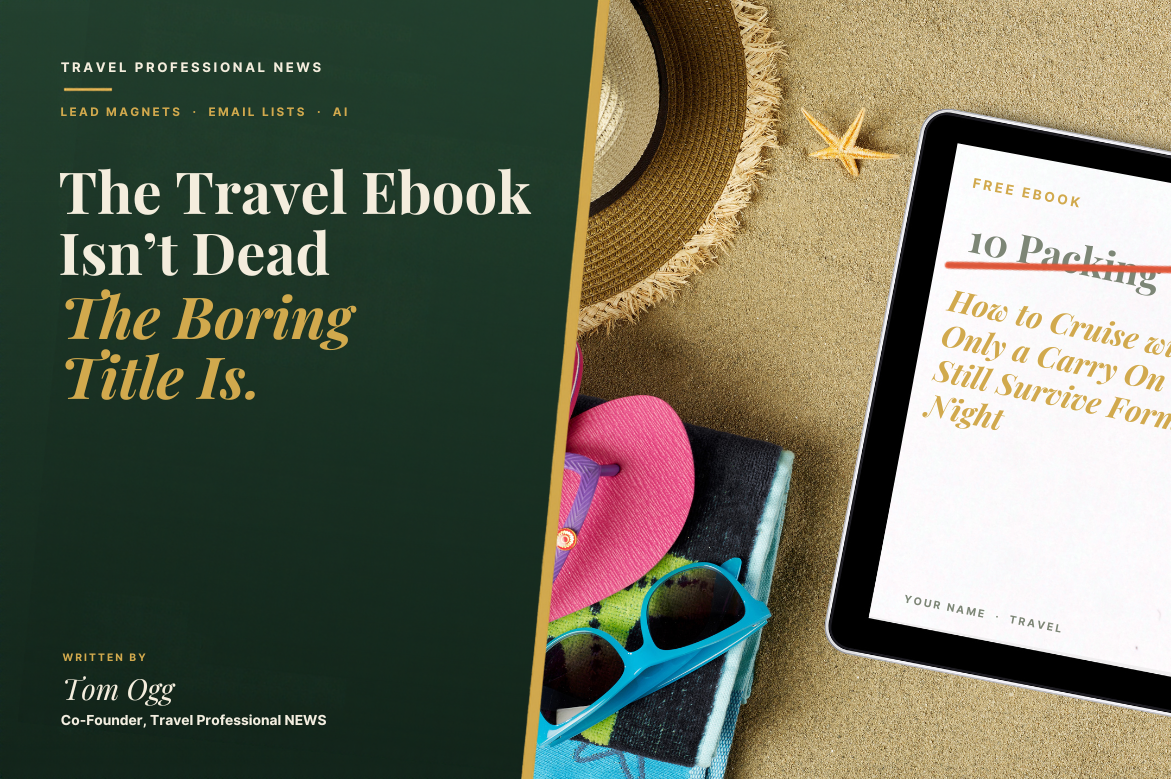
That changes the math. A “10 Packing Tips” ebook was once a reasonable trade for an email address. Today it’s a commodity, and commodities don’t get anyone to fill out a form.
AI draws from an insane amount of content that it has “learned”. In much the same way as search engines produce the same result for the same keyword search term, AI will deliver the same result for the same prompt. This is the critical difference between you and AI.
What AI can’t easily produce is your experience. It doesn’t know what happened when your client’s ship skipped Santorini because of weather, or which cabin category on a particular river ship sits too close to the engine room. It hasn’t eaten at the little restaurant in Punta Mita where you’d send your own mother. It doesn’t have your supplier relationships, and it won’t call the cruise line at 6:00 a.m. when a flight cancellation threatens an embarkation.
AI tools also get things wrong, sometimes confidently. They can recommend a hotel that closed, quote entry requirements that have changed, or invent a shore excursion that never existed. A traveler who has been burned once by a chatbot itinerary is a prime candidate for an advisor’s ebook.
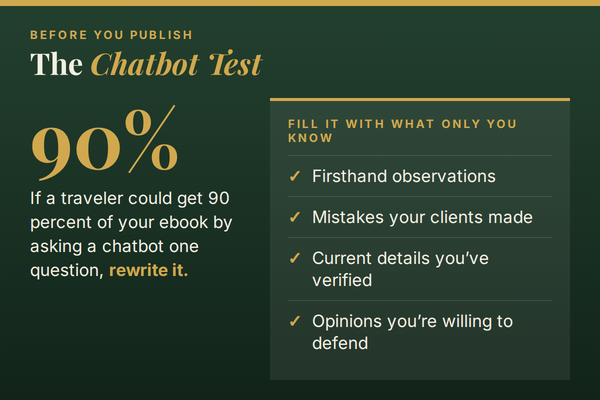
Here is a simple test before you publish: if a traveler could get 90 percent of your ebook by asking a chatbot one question, rewrite it. Fill it with the things only you know: firsthand observations, mistakes your clients made so readers don’t repeat them, current details you’ve verified, and opinions you’re willing to defend.
Why the Ebook Still Earns Its Keep
Some things haven’t changed at all. The ebook remains one of the best tools an advisor has for growing a list, for three reasons.
The reader prequalifies themselves. Someone who lands on your page for “How to Cruise the Baltic Without Overspending on Excursions” arrived through a specific search, ad, video or social post. You already know their interest, their likely budget and possibly their timing. That’s far more useful than a random follower.
You own the list. Social platforms change their algorithms whenever they please, and an account with thousands of followers can see it reach collapse overnight. An email list belongs to you. Nobody can throttle it.
It starts a relationship rather than closing a sale. Nobody books a $14,000 river cruise because of a PDF. They book because the PDF proved you know what you’re talking about, and the next six emails proved it again.
The Title Does the Heavy Lifting
For years I’ve maintained that the title is the single most important factor in whether a reader downloads an ebook. That view has aged well; if anything, it matters more now.
Your title used to appear mostly on a landing page. Today it shows up as a thumbnail in an Instagram post, a line in a Facebook ad, a caption on a short video and a QR code on a flyer at your cruise night presentation. In most of those places the reader gives it about two seconds. The title has to make the case on its own.
The title formulas that worked years ago still work, with some updates:
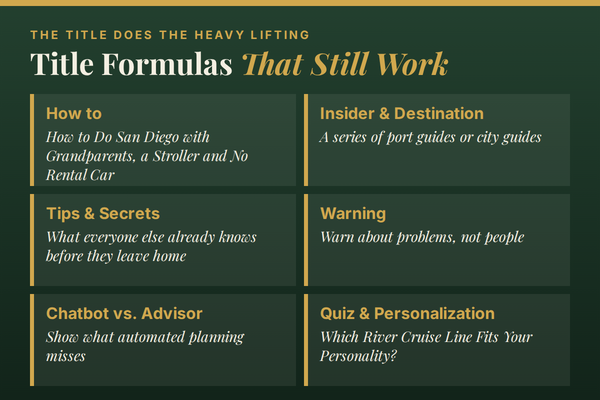
How to Titles promise a specific outcome. They’re natural for travel, but “How to Visit San Diego Like a Local” now competes with every AI summary on earth. Narrow it: “How to Do San Diego with Grandparents, a Stroller and No Rental Car.”
Insider and Destination Titles establish authority. A series of port guides or city guides positions you as the expert in a region, especially when each one contains details you collected personally.
Tips and Secrets Titles tap into the fear of missing something important. Travelers want to know what everyone else already knows before they leave home.
Warning Titles create urgency, but use them responsibly. Some of the attention grabbing titles I suggested in the past would make me wince today. A title that insults an entire destination may get clicks, but it can also alienate readers and suppliers alike. Warn about problems, not people.
Two newer formats deserve a spot on the list. “Chatbot vs. advisor” titles turn the AI conversation to your advantage by showing what automated planning misses. Quiz and personalization titles (“Which River Cruise Line Fits Your Personality?”) perform well because readers love learning about themselves, and the answers tell you exactly what to send them next.
Let AI Do the Grunt Work, Not the Thinking
When I first wrote about ebook titles, I noted that I couldn’t find a title generator built specifically for travel and suggested searching for generic ones online. That problem is solved. Any major chatbot is now a capable title brainstorming partner, as long as you give it real direction.
Instead of asking “give me ebook titles about cruising,” try something like: “I’m a travel advisor specializing in Alaska cruises for retirees who have never cruised. Give me 20 ebook titles that are humorous, specific and promise a practical benefit. Avoid clichés.” You’ll throw out most of them, but three or four will spark something better.
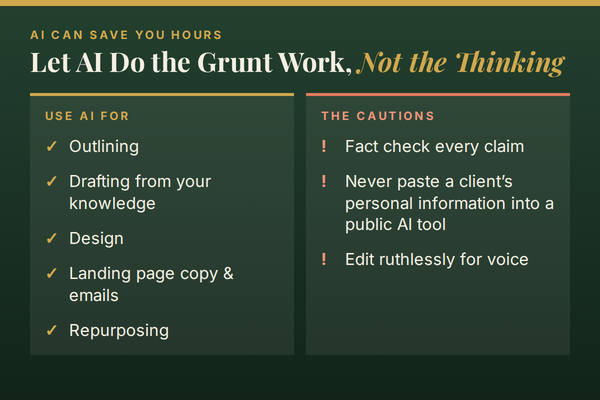
AI can save you hours across the whole project:
- Outlining: Describe your expertise and audience, then ask for a chapter structure you can reorganize.
- Drafting from your knowledge: Record a voice memo telling client stories, transcribe it and ask an AI tool to shape it into readable sections. The insight stays yours; the AI handles the cleanup.
- Design: Tools like Canva, with its built in AI features, can produce a professional cover and layout without a graphic designer.
- Landing page copy and email sequences: AI writes a strong first draft of the welcome email and the nurture sequence that follows.
- Repurposing: Each chapter can become a blog post, several social posts, a short video script and a newsletter feature.
Now the cautions. Fact check every claim, because AI will invent details with complete confidence. Never paste a client’s personal information into a public AI tool. And edit ruthlessly for voice. Readers have learned to recognize bland, AI generated prose, and nothing kills credibility faster than an “expert guide” that sounds like it was written by nobody in particular.
The Download Is the Beginning, Not the Finish Line
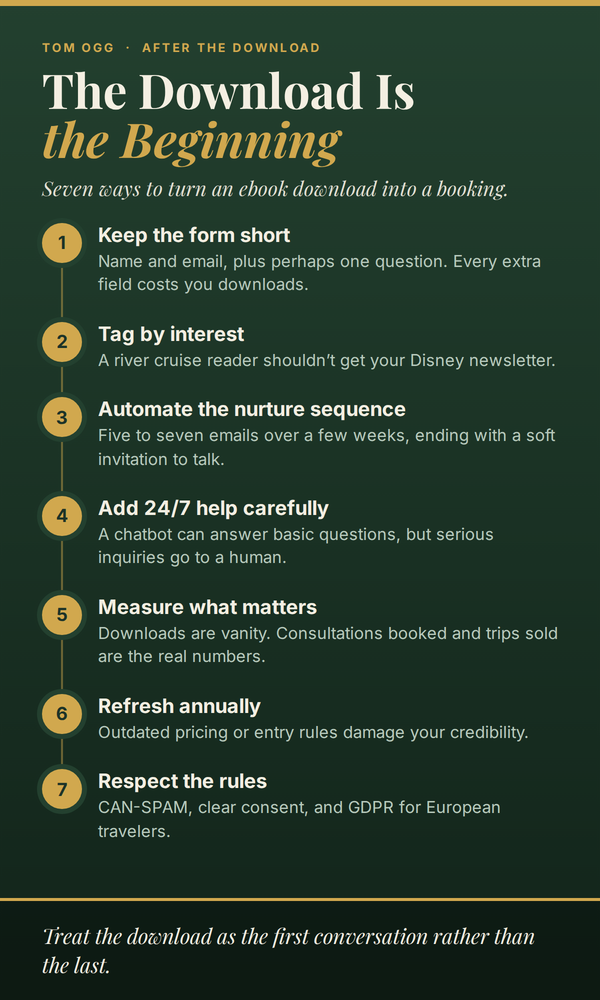
The biggest mistake I’ve watched advisors make for decades isn’t a weak ebook; it’s what happens after the download: nothing. The PDF goes out, the name sits in a spreadsheet, and six months later the advisor wonders why the list never produced a booking.
Modern tools make that mistake inexcusable:
- Keep the form short. Name and email, plus perhaps one question such as “When are you hoping to travel?” Every extra field costs you downloads.
- Tag by interest. Your CRM or email platform should automatically tag subscribers by the ebook they requested. A river cruise reader shouldn’t get your Disney newsletter.
- Automate the nurture sequence. Five to seven emails over a few weeks, each delivering more value and ending with a soft invitation to talk.
- Add 24/7 help carefully. An AI chatbot on your website can answer basic questions at midnight, but make sure it hands serious inquiries to a human, which is your whole value proposition.
- Measure what matters. Downloads are vanity. Consultations booked and trips sold are the real numbers.
- Refresh annually. An ebook full of outdated pricing or entry rules damages the credibility it was supposed to build.
- Respect the rules. Follow CAN-SPAM requirements in the United States, use clear consent, and be aware of stricter privacy laws like GDPR if you market to European travelers.
Ebook Titles for 2026 and Beyond
Borrow these, adapt them or use them to get unstuck. Every title should be backed by content that delivers on its promise.
Travel in General
- Your Chatbot Planned Your Trip. Here’s Everything It Forgot.
- Passports, REAL ID and the Paperwork That Ruins Vacations
- The Basic Economy Survival Guide: What You Actually Get (Spoiler: A Seat, Probably)
- 9 Travel Apps Worth Keeping and 40 You Can Delete
- How to Find a Great Airfare Without Opening 37 Browser Tabs
- Vacation Rental or Hotel? Let the Cleaning Fee Decide
- Jet Lag Is Optional: A Practical Plan for Long Haul Flights
- Europe’s New Border Rules, Explained Before the Officer Explains Them to You
- Pack Like a Flight Attendant: Lessons from People Who Live Out of a Suitcase
Family Travel
- Screens on a Plane: The Parent’s Guide to Guilt Free Survival
- How to Plan a Family Trip Your Teenager Won’t Rate One Star
- Disney World Without the Meltdown (Yours, Not the Kids’)
- Grandparents, Grandkids and One Itinerary: Multigenerational Travel Without the Drama
- Delayed Again? 10 Ways to Keep Kids Happy at Gate B47
- The Family Vacation Budget Line Nobody Plans For: Snacks
All Inclusive Resorts
- 15 Things All Inclusive Resorts Won’t Put in the Brochure
- The Honest Guide to Tipping at an All Inclusive (Yes, Even Though It’s “Included”)
- Leave the Resort: How to Actually See the Country You Flew To
- All Inclusive: Expectations vs. Reality vs. Your Instagram
- Why Mom Was Right About All Inclusive Resorts
- Swim Up Bars and Sunscreen: The Adults Only Resort Handbook
Ocean Cruising
- 17 Things the Cruise Lines Would Rather You Learn Onboard
- The Private Island Arms Race: Which Cruise Line Beach Day Is Worth It?
- The Drink Package Math Problem, Solved (Bring a Calculator and a Designated Napper)
- How to Cruise with Only a Carry On and Still Survive Formal Night
- Shore Excursions: See More, Spend Less and Make It Back Before the Ship Leaves
- Pre and Post Cruise Planning, So the Vacation Doesn’t Start with a Missed Flight
- 44 Cruise Jokes to Survive Assigned Dining
- Where Is My Luggage? A Calm Person’s Guide to Embarkation Day
River Cruising
- 12 Things to Know About River Cruising Before You Book
- Low Water, High Expectations: What Happens When the Rhine Won’t Cooperate
- Viking, AmaWaterways, Avalon and Uniworld: How to Tell Them Apart
- Take This Quiz to Find Your River Cruise Match
- River vs. Ocean: Which Cruise Fits Your Personality?
- The Christmas Markets River Cruise Survival Guide (Mulled Wine Included)
Travel in the AI Era
- Can a Robot Plan Your Honeymoon? We Tested It So You Don’t Have To
- How to Spot Fake Listings, AI Scams and Too Good to Be True Travel Deals
The Bottom Line
The technology around the travel ebook has changed almost beyond recognition. The psychology hasn’t. People still guard their inboxes, and they still give their email address to someone who offers something genuinely worth having.
In 2026, “worth having” means something a chatbot can’t hand them for free: your experience, your judgment and your willingness to pick up the phone when things go sideways. Put that in the ebook, wrap it in a title that earns the click, and treat the download as the first conversation rather than the last.