
The Name You Want Is Taken. The Owner Is Hidden. The Rules Changed. Here Is the 2026 Playbook.
Written By: Tom Ogg, Co-Founder and Co-Owner – Travel Professional NEWS

In 2020, the answer was a phone call and an escrow account. In 2026 it still is, but the owner is harder to find, the .ai crowd has inflated everyone’s expectations, and AI search has quietly changed what a domain name is actually worth to a travel advisor.
You Probably Don’t Need That Exact Name
My advice in 2020 was straightforward. If your business name is taken, pick a domain that describes your niche. If you sell scuba trips to Hawaii, a name like HawaiiScubaSpecialist.com tells the world exactly what you do. I still like that thinking, but for a different reason than the one I gave at the time.
Back then I argued that a keyword domain would rank high for its keywords, and I suggested that a name like TravelInsuranceAgency.com would all but guarantee a top search position. That was optimistic even in 2020. Google had been discounting the ranking bonus of exact match domains since a 2012 algorithm update, and content, links and reputation were already doing the heavy lifting.
In 2026 the keyword argument is weaker still. When Pew Research Center tracked real Google searches, it found that people clicked a traditional result only 8% of the time when an AI Overview appeared, versus 15% when one did not. SparkToro’s latest study found that the U.S. zero click rate on Google climbed from about 60% in 2024 to 68% in early 2026. A lot of the questions your future clients ask now get answered right on the results page, before anyone sees a URL.
Here is my read on what that means (analysis, not a study): the domain name is no longer a ranking trick. It is a brand asset. It needs to be easy to say on a podcast, easy to remember after a cruise night presentation, easy to spell when a client dictates it to her phone, and distinctive enough that when a traveler asks ChatGPT or Gemini to recommend a Hawaii dive specialist, your business name is something the machine can latch onto. A descriptive name still helps people understand you instantly. It just won’t do your marketing for you.
The .ai Gold Rush, and Whether You Should Stake a Claim
Anyone who has attended a travel conference lately has heard the letters “AI” roughly 4,000 times per breakout session, so it was inevitable that someone would ask me whether they should buy a .ai domain.
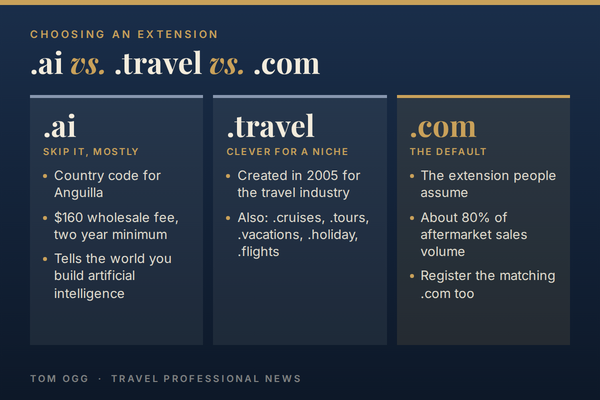
Some context. The .ai extension is actually the country code for Anguilla, a small Caribbean island that has become a very lucky landlord. Registrations of .ai names passed 1 million at the start of 2026, and the government earned an estimated $93 million from .ai fees in 2025, roughly 47% of its total revenue. Prices reflect the demand: every registrar pays Anguilla a fixed $160 wholesale fee for a mandatory two year registration, then adds its own markup. On the resale side, bot.ai sold on Sedo for $1.2 million in February 2026, the first publicly recorded seven figure sale of a .ai name.
My verdict for most travel advisors: skip it. A .ai address tells the world you build artificial intelligence. Unless you are actually launching an AI trip planning product, you are paying a premium to send the wrong message. Worse, the most valuable thing a travel advisor sells today is human judgment: knowing which cabin sits directly under the pool deck, and picking up the phone when a flight cancels at midnight. Branding yourself as an AI company undercuts that message at the very moment consumers are asking themselves whether they need a human at all.
There are exceptions. If you or your host agency is building a genuine tool, such as a client facing chatbot or an itinerary app, a .ai name can make sense for that product. Just remember that the renewal bill arrives every two years, whether the app takes off or not.
The Travel Extensions Hiding in Plain Sight
If you want an extension that says “travel,” you have options that didn’t get nearly as much hype. The .travel extension was created in 2005, and registrants must declare that they provide, or plan to provide, services, products or content to the travel industry. The 2012 expansion also produced such as extensions .cruises, .tours, .vacations, .holiday and .flights. To explore travel oriented domain names visit INWXNetim
These can be clever, especially for a niche. The catch is that .com remains the extension people assume by default. If you build your brand on a .cruises address, try to register the matching .com too, or at least know who owns it, because some of your clients will type .com out of pure habit, and some of your email will follow them there.
More extensions are coming. ICANN’s first new application window in over a decade opened on April 30, 2026 and closed on August 12, 2026, and ICANN has reported more than 1,600 applications. Don’t hold your breath, though: the first new extensions from this round are not expected to launch until around the second quarter of 2028. I haven’t seen a verified list of which travel related strings were applied for, so I won’t guess.
Finding the Owner Now That WHOIS Went Dark
In 2020, I told you to run a WHOIS lookup and you’d find the owner’s name, phone number and email address. That advice has aged about as well as a paper airline ticket.
Two things happened. First, most registrant data has been redacted since GDPR enforcement began in 2018. Second, ICANN sunset WHOIS on January 28, 2025 and made the Registration Data Access Protocol (RDAP) the official source for registration data. A public RDAP lookup today confirms technical details such as registration dates, registrar and nameservers, but the owner’s identity is usually hidden.
So how do you reach the owner in 2026?
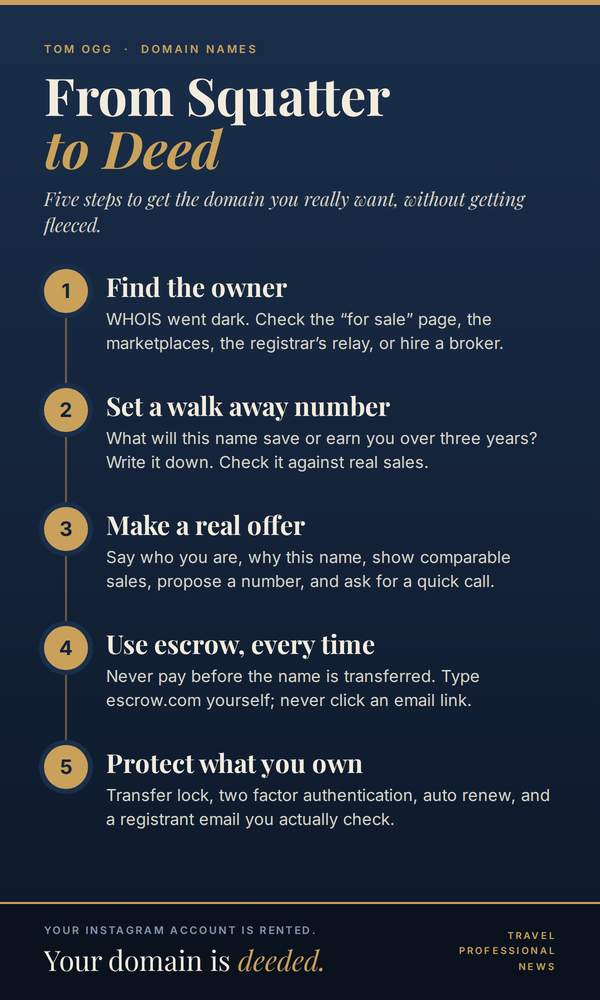
Start with the domain itself. Many parked domains carry a “for sale” banner or a landing page with an offer form. That is the owner telling you how he wants to be contacted.
Check the major marketplaces. Afternic, which GoDaddy operates, syndicates listings to more than 100 registrar partners, so a name listed there shows up as a premium option at GoDaddy, Namecheap and elsewhere. Sedo, Atom and Spaceship’s SellerHub are worth checking too.
Use the registrar’s relay. When contact details are redacted, the registrar must provide an anonymized email address or a web form so messages can still reach the registrant. Run the name through ICANN Lookup, note the registrar, and look for its contact option.
Hire a broker. For names that aren’t listed anywhere, GoDaddy’s Domain Broker Service charges an upfront fee, observed between $69.99 and $119.99, plus a 20% commission.
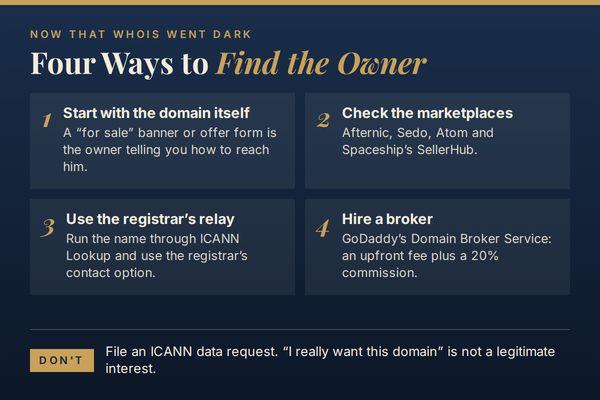
One thing not to do: ICANN’s Registration Data Request Service is intended for law enforcement, intellectual property professionals, consumer protection advocates, cybersecurity specialists and government officials. “I really want this domain” is not a legitimate interest, and filing a bogus request is a good way to annoy the people you need.
In 2020 I also claimed that buying through a marketplace guaranteed you’d pay the highest possible price. I’d soften that today. A posted Buy Now price is often the fastest honest route to a deal, and it saves both sides a lot of email tennis. Just read the fine print on fees: Sedo can add a 10% buyer fee, while Afternic charges buyers nothing extra.
This is the part of my original advice that holds up best: a domain is worth what it can realistically help you earn, not what you wish it were worth.
In 2020 I ran a travel insurance example: 1,000 policies a month at $45 of revenue each works out to about $540,000 a year, so a strong travel insurance domain could justify a serious price. The math is fine as a thought experiment. The flaw is the assumption buried inside it. The domain doesn’t sell those policies; your marketing, your content, your licensing (yes, check your state’s rules on selling travel insurance) and your service sell them. The name only makes that work a little easier.
A better question for 2026: over the next three years, what will this name save me in marketing costs or earn me in extra business? Pick a walk away number before the first conversation, and write it down so you can’t talk yourself out of it later. Then sanity check your number against real sales. Sites such as NameBio track reported domain sales, and one industry knowledge base puts the average reported aftermarket sale at roughly $2,000 to $3,000, with .com names making up about 80% of sales volume. The seven figure headlines are outliers; don’t let them anchor your expectations, or the seller’s.
The Offer: Why I Still Prefer a Real Conversation
I own a lot of domain names, and I receive offers on some of them every month. In all those years, I can’t remember selling a name when the first contact was a lowball email. Nearly every meaningful sale started with a phone call, or an email from a serious buyer or an attorney who clearly knew what the name was worth.
That hasn’t changed. What has changed is that you often can’t find a phone number anymore, so your first message has to do the job a phone call used to do. Say who you are and what your business does. Explain why you want this specific name. Show that you’ve done your homework on comparable sales. Propose a realistic number or range, and ask for a quick call.
If the owner is a professional domain investor, expect limited wiggle room; that’s how they make a living. If the asking price fits your budget, buy it and stop agonizing. If it doesn’t, walk the owner through the reasoning behind your number. Reasonable people respond to reasoning. What they don’t respond to is $50 for a name they value at $5,000. Lowball an experienced owner and your email goes straight into the folder labeled “Tire Kickers.”
Let AI Do the Legwork, Not the Deal
This is where 2026 genuinely beats 2020. AI tools can compress days of grunt work into an afternoon.
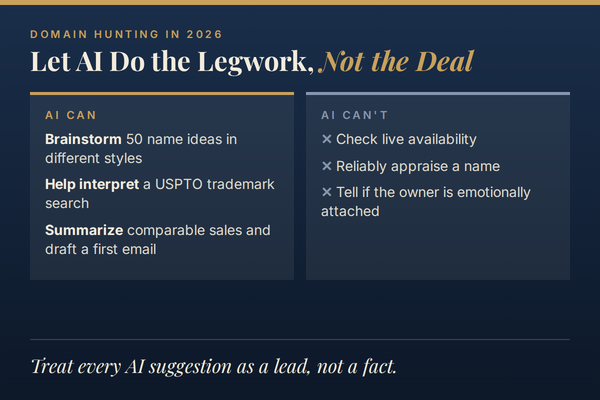
Brainstorming: Describe your niche to Claude, ChatGPT or Gemini and ask for 50 name ideas in different styles: descriptive, brandable, playful, local. Registrars have built this into their search tools as well. GoDaddy includes its Airo AI features with a new domain purchase, and Namecheap offers a free Business Name Generator that pairs name ideas with available domains.
Trademark Screening: Before you spend a dime, search the USPTO database. An AI assistant can help you interpret what you find, but verify it yourself, and talk to an attorney if the name matters to your business.
Research and Outreach: Ask AI to summarize comparable sales you’ve gathered, list the pros and cons of each candidate name, and draft a first email to the owner that sounds like a professional rather than a desperate fan.
What AI Can’t Do: Most chat assistants don’t check live availability, so they will cheerfully suggest a “perfect” name that was registered in 2004. They can’t reliably appraise a name, and they certainly can’t tell whether the owner is emotionally attached to it because it was his late father’s business. Treat every AI suggestion as a lead, not a fact.
Escrow, Lookalikes, and the Scammers Who Read This Article Too
My 2020 rule stands unchanged: use an escrow service, and never pay for a domain before it has been transferred to you. Escrow.com holds the money until you confirm the name is in your account, which protects both sides.
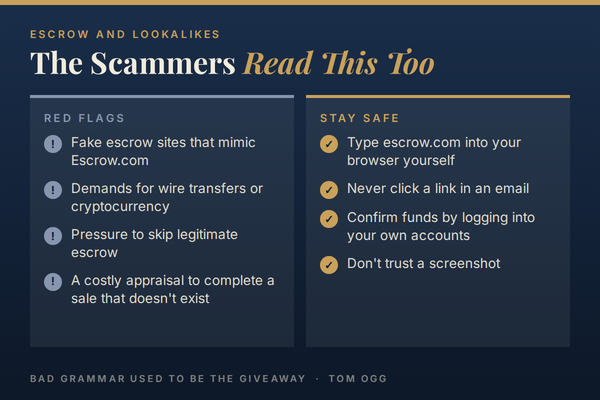
The threats around that rule have gotten smarter, though. Fraud watchers warn of fake escrow sites built on names that mimic Escrow.com, along with demands for wire transfers or cryptocurrency and pressure to skip legitimate escrow. Another classic involves asking an owner to pay for a costly appraisal to complete a sale that doesn’t exist.
Here’s my own observation: bad grammar used to be the giveaway. Thanks to AI writing tools, scam emails are now as polished as a luxury brochure. So type escrow.com into your browser yourself; never click a link in an email. Confirm funds and transfers by logging into your own accounts, not by trusting a screenshot.
Once the name is yours, protect it. Turn on your registrar’s transfer lock, which blocks transfers to another registrar while it’s active and serves as basic protection against domain theft. Add two factor authentication, switch on auto renew, and make sure the registrant email is one you actually check.
What Hasn’t Changed
Social media platforms change their algorithms, suppliers change their commission structures, and AI changes how travelers search. Through all of it, your domain name remains the one piece of online real estate you actually own. Your Instagram account is rented. Your domain is deeded.
And even in a world where AI answers the question before anyone clicks, those AI tools still recommend businesses by name. Make sure yours is one worth remembering.
So today, look up the name you really want. If it’s available, register it before you finish your coffee. If it isn’t, you now know how to find the owner, what to offer, and how to close the deal without getting fleeced.