

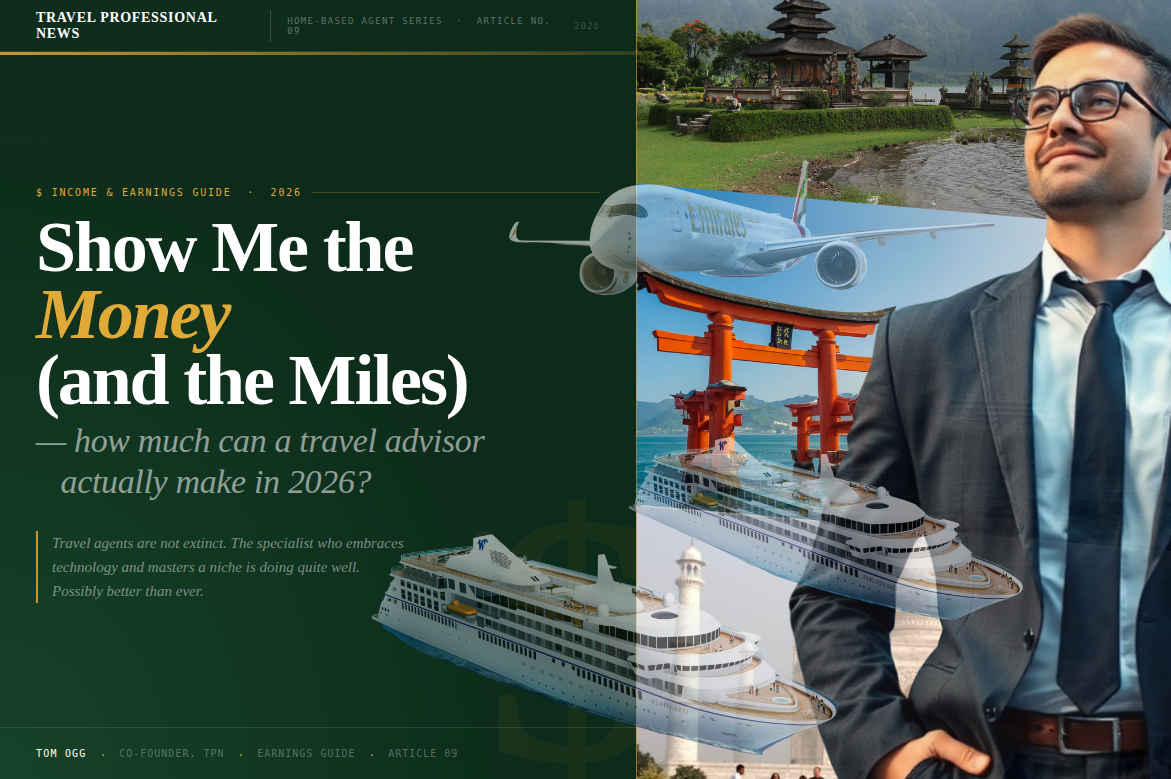
How travel agents are making serious bank in 2026, and why the robots are actually helping, not replacing them.
Written By: Tom Ogg, Co-Founder and Co-Owner – Travel Professional NEWS

Let’s get one thing straight: travel agents are not extinct. They are not a cautionary tale. They are not the Blockbuster Video of the service industry. In fact, the travel agent who specializes wisely, embraces technology, and masters a compelling niche is doing quite well, possibly better than the person who spent $400 booking a “budget” trip online, ended up in a hotel above a nightclub, and had no one to call when their flight was canceled at 11 p.m. on a Tuesday. That person wished they had a travel agent. That person always wishes they had a travel agent.
We are now firmly in 2026, and digital transformation has not killed the travel advisor. Instead, AI and travel advisors are working together to deliver better client experiences and more profitable businesses, it has cleared away the riffraff and left behind a cohort of specialists who are thriving precisely because they offer what no algorithm can: judgment, relationships, and the ability to say “trust me, don’t book that resort in August.”
The COVID pandemic (which we will not discuss here at length, but which was, by all accounts, a lot, taught consumers something invaluable: when the world shuts down and your non-refundable vacation evaporates, you want a human being in your corner. Since then, travel has roared back. Demand for qualified travel advisors is soaring. And with social media, affordable websites, AI assistants, and digital marketing tools now widely available, a savvy travel advisor can specialize in high-commission niches and market their expertise globally, from their kitchen table, if they so choose.
“The algorithm books a seat. The travel advisor books an experience. Clients who learn the difference rarely go back.”
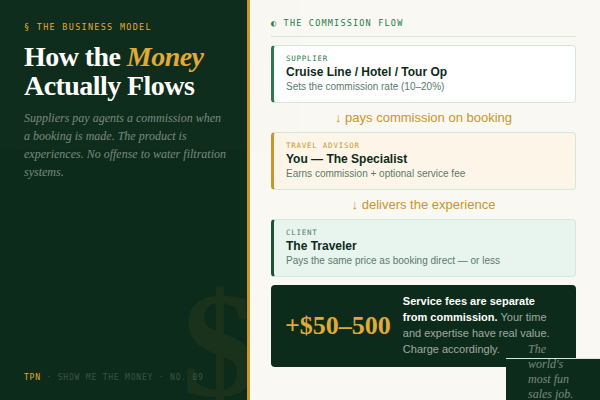
The business model itself is elegantly simple: travel agents work on behalf of suppliers, cruise lines, tour operators, resorts, and the like, who pay a commission when the agent completes a sale. It is, essentially, the world’s most fun sales job, but one where the product is experiences rather than, say, industrial-grade water filtration systems. No offense to industrial-grade water filtration systems.
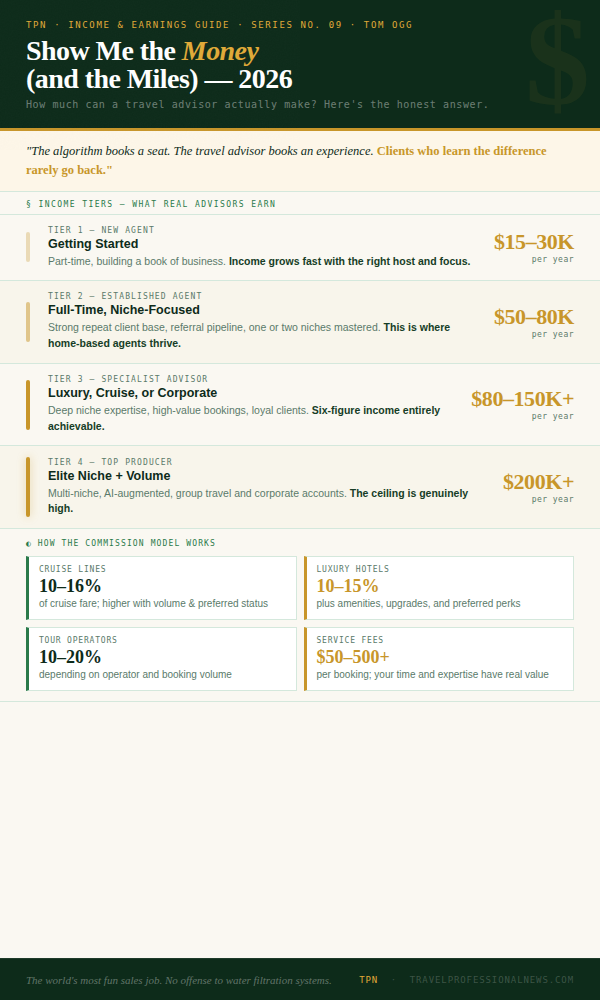
So, how much do travel advisors actually make in 2026?
When people ask, “How Much Do Travel Advisors Make in 2026,” the honest answer is that it depends entirely on productivity, specialization, and business strategy. The travel industry is full of agents making six-figure incomes and agents who treat it primarily as a mechanism for obtaining cheap trips to Cabo. Both are valid life choices, but only one of them qualifies as a business strategy.
Being a home-based travel agent is a business, not a job with a guaranteed paycheck. You make money proportional to your productivity, your specialization, and your willingness to do the work. The good news is that the upside is genuinely significant. The great news is that “the work” often involves visiting beautiful places and telling people about them.
Understanding how much do travel advisors make often starts with looking at the niches that generate the highest commissions.
Where the Real Money Lives
Let us talk specifics, because vagueness is for people who don’t want to pay their mortgage. The most profitable niches in 2026 break down as follows:
| Luxury, River & Expedition Cruises | 10–20% |
| Tour Operator Packages | 12–20%+ |
| All-Inclusive Resorts | 10%+ overrides |
| Destination Weddings & Honeymoons | Negotiable |
| Group Travel (self-packaged) | 10–15%+ |
| Sustainable & Eco Travel | 10–20% |
| Solo & Women-Only Travel | 10–25% |
Cruise Lines remain among the most lucrative commission sources in the business. Base commissions run from 10 to 16 percent, with the potential to hit 20 percent through volume bonuses and incentive programs. Luxury, river, and expedition cruises sit at the top of the commission food chain, reflecting both their premium pricing and the complexity of booking them, a complexity that requires, you guessed it, a knowledgeable human being.
All-inclusive Resorts deserve special mention because agents sometimes underestimate them. When a resort is truly all-inclusive, you are earning commission on everything: the rooms, the food, the drinks, the activities, the spa visits, and whatever elaborate poolside ritual the guests invent by day three. Many all-inclusive properties also work through tour operators who may offer even better rates than booking directly.
Destination Weddings are the gift that keeps on giving. Couples spend $25,000 to $80,000 on average. Then comes the wedding guests who need bookings. Then the anniversary trips. One wedding client can generate years of business, and they will tell everyone at the reception about their wonderful agent.
The Dot-AI Gold Rush: What’s in a Name?
Now, here is the 2026 twist that is simultaneously amusing and strategically important: the AI naming craze has officially hit the travel industry. Agencies and advisors across the country have been rebranding with “.ai” domains and AI-forward names at a pace that would make a Silicon Valley venture capitalist blush.
We have seen, any .ai names for travel niches and agency names. But the point is that the “.ai” suffix has become the travel industry’s equivalent of putting “boutique” in a hotel name, everyone is doing it, and it signals sophistication, whether or not a single neural network was harmed in the making of the booking.
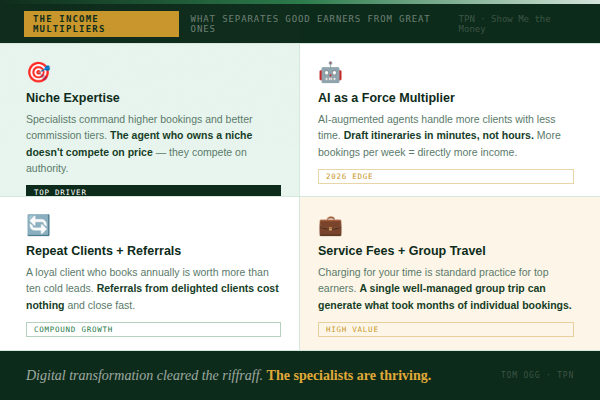
The real story, though, is that AI tools have genuinely transformed what a solo travel advisor can accomplish. Agents who have embraced AI-assisted customer relationship management, automated follow-up campaigns, AI-generated itinerary drafting, and smart lead-scoring systems are handling client volumes that would have required a full staff just five years ago. The AI does the administrative grunt work; the advisor does the relationship-building and expertise delivery. It is, frankly, a very good arrangement.
“AI handles the spreadsheets. The advisor handles the 2 a.m. call when the cruise ship changes itineraries. Some things still require a human, preferably a caffeinated one.”
Niches That Are Printing Money in 2026
Sustainable Travel has graduated from niche curiosity to a genuine revenue driver. Gen Z and Millennials, who now constitute a significant and growing share of the travel market, treat sustainability as a baseline expectation, not a bonus feature. Agents who have developed genuine expertise in eco-certified properties, low-impact itineraries, and carbon-offset programs are attracting a loyal, values-aligned clientele. Commissions run 10 to 20 percent, and the moral smugness is, we are told, priceless.
Workations and Digital Nomad Travel represent a structural shift, not a fad. Remote work normalized during the pandemic and has not un-normalized. Countless professionals are now combining extended work stays with travel, and a growing number of destinations, from Barbados to Bali to Portugal, offer dedicated digital nomad visas. Hotels have redesigned themselves around reliable Wi-Fi and proper desk chairs. Savvy agents who specialize in this space are booking extended stays, multi-destination itineraries, and visa logistics at commissions of 10 to 15 percent.
Solo and Women-Only Travel is one of the fastest-growing and most profitable niches in the industry. Women traveling solo or in curated groups represent a massive, underserved market, one that demands thoughtful itinerary design, safety considerations, and community-oriented experiences that require genuine expertise. Recurring group trips for women travelers command commissions of 10 to 25 percent and generate extraordinary word-of-mouth referrals. If you are not in this space yet, someone else is.
How to Stay Ahead of the Herd
The travel advisors who will thrive through the remainder of this decade share several characteristics. They cultivate a small number of high-value clients rather than chasing volume. They invest in specialized certifications and deep destination knowledge. They build genuine relationships with premium suppliers, relationships that translate into better rates, priority service, and the kind of inside access that no booking engine can replicate.
And yes, they use AI. Not as a gimmick. Not to slap “.ai” on their business card and call it a day. They use it as a genuine competitive weapon: to work faster, serve more clients at a high level, and spend the time they save doing what actually generates revenue, talking to people, building trust, and booking extraordinary experiences that clients will remember and rave about. For anyone looking to increase earnings, choosing a profitable niche, embracing AI tools, and working with a top host agency can create a strong foundation for long-term success.
For anyone wondering how much do travel advisors make, the answer increasingly depends on niche expertise, client relationships, and the effective use of technology. The future of the travel industry belongs to specialists who combine human expertise with smart technology. That combination is, as it turns out, very difficult to automate. The clients who discover it are very difficult to lose.
Now, if you will excuse us, we have a river cruise to research. For professional reasons, obviously.