

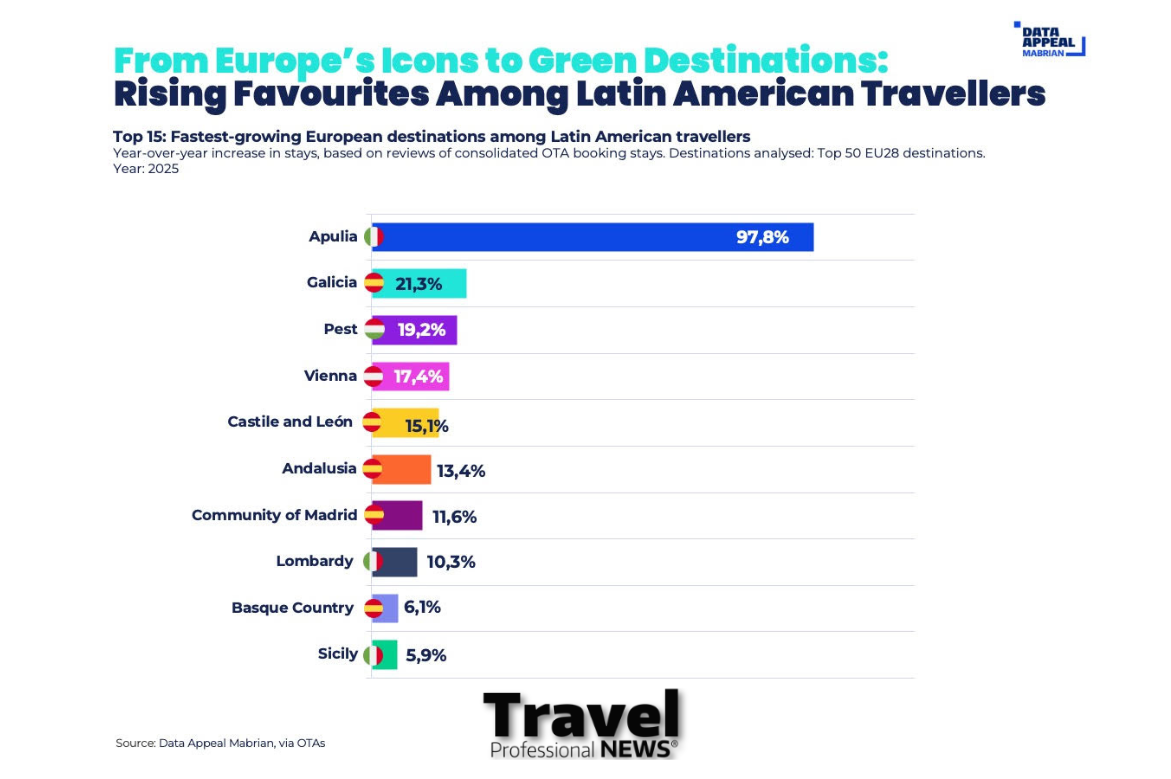
Data Appeal’s tourism intelligence reveals that cultural heritage accounts for 40.3% of travel motivations to Europe and that, while iconic destinations remain highly attractive, interest is growing in emerging destinations such as Apulia (Italy), Galicia (Spain) and Budapest (Hungary).
FLORENCE (Italy) August 11, 2026 – Spain and Italy continue to strengthen their position as the leading gateways for Latin American travel to Europe. Data from Data Appeal Mabrian, the tourism intelligence platform of The Data Appeal Company / Almaviva Group, shows that the two countries account for 54.2% of stays generated by the main Latin American source markets in 2025, while interest continues to expand towards alternative destinations beyond Europe’s most iconic cities and tourism hotspots.

The study analyses consolidated travel demand from the five leading Latin American source markets -Argentina, Colombia, Mexico, Brazil and Chile to European destinations-, using aggregated data for the United Kingdom, Spain, Italy, France and Germany.
The analysis shows that cultural heritage, the arts and local traditions account for 40.3% of travel motivations to Europe, ahead of other key demand drivers such as gastronomy (12.5%), family travel (11.9%) and shopping (11.8%). This trend confirms that Latin American travellers are increasingly seeking experiences that offer stronger emotional connections and cultural value.
While Europe’s best-known destinations remain highly attractive, demand for alternative regions is gaining momentum. In 2025, five Spanish and six Italian regions together accounted for 54.2% of stays by Latin American travellers in Europe. At the same time, Apulia (Italy) has nearly doubled its number of stays since 2023, while Galicia (Spain) recorded growth of 21.3% and Pest (Budapest, Hungary) increased by 19.2%.
The study also highlights a traveller profile characterised by advance planning. Latin Americans book their trips to Europe an average of 72.7 days in advance and spend an average of 14.5 days travelling across the continent. In addition, couples (40.6%) and families (27.5%) dominate demand, together accounting for more than two-thirds of trips.
“Europe benefits from a structural advantage built on its heritage, diversity and cultural depth, attributes that naturally resonate with Latin American travellers,” said Carlos Cendra, Chief Marketing Officer at Data Appeal. “However, the European destinations that will stand out are those that can better design and deliver experiences for these travellers. The challenge lies in designing tourism experiences, enhancing the destination experience and refining distribution strategies, taking into account not only the overall potential of this market but also the specific characteristics and needs of each source country.”
Discover the full findings in the report Understanding Latin American Travel Demand Trends in Europe: www.datappeal.io/