

How to Build a Unique Value Proposition That Stands Out in an AI-Saturated Travel Market
Written By: Tom Ogg, Co-Founder and Co-Owner – Travel Professional NEWS
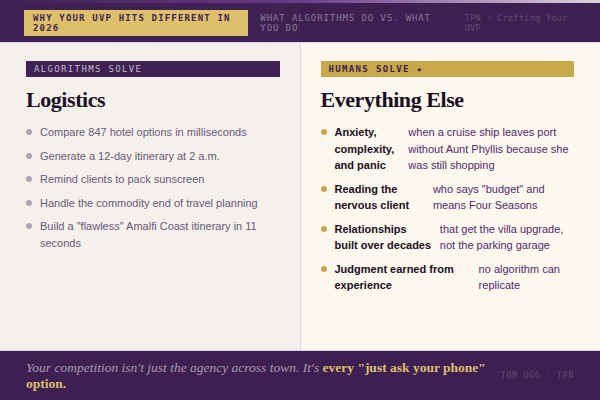
Let’s address the robot in the room. Since the explosion of AI travel tools beginning in earnest around 2023, every armchair traveler now has a pocket-sized digital concierge that can compare 847 hotel options, generate a 12-day itinerary, and remind them to pack sunscreen. For roughly the same effort it takes to microwave popcorn.

So here you are, a human travel professional, staring down a ChatGPT plugin that just built a flawless Amalfi Coast itinerary in 11 seconds. And you might be thinking: “Is it too late to pivot to competitive dog grooming?”
The answer, emphatically, is no. But it does mean your Unique Value Proposition (UVP) has never mattered more. In fact, if you’re starting or growing a travel business in 2026 without a clearly defined UVP, you’re not just fighting uphill, you’re fighting uphill while an AI rolls boulders at you.
A UVP isn’t just a nice marketing tagline to slap on a business card. In today’s AI-saturated travel landscape, it’s your survival strategy.
What Is a Unique Value Proposition, And Why Does It Hit Different in 2026?
A Unique Value Proposition (UVP) sometimes called a Unique Selling Proposition (USP) by marketers who enjoy the alliteration, is a concise statement explaining why a client should book their vacation with you instead of anyone (or anything) else. And in 2026, that “anything else” is doing a LOT of heavy lifting.
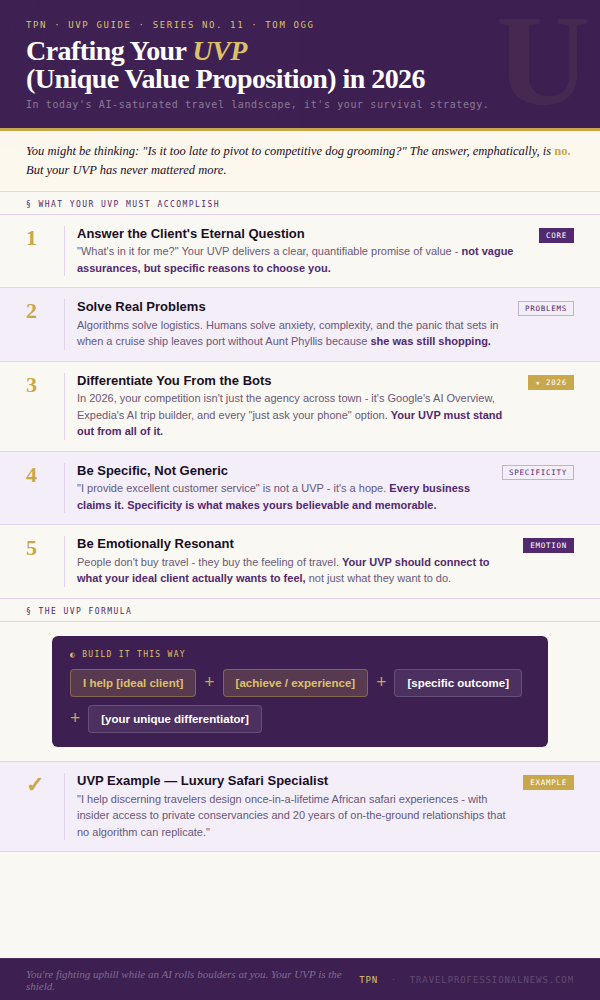
Here’s what your UVP must accomplish to remain relevant:
Answer the client’s eternal question:
“What’s in it for me?” Your UVP delivers a clear, quantifiable promise of value, not vague assurances, but specific reasons to choose you.
Solve real problems:
Algorithms solve logistics. Humans solve anxiety, complexity, and the panic that sets in when a cruise ship leaves port without Aunt Phyllis because she was still shopping. What problems do you uniquely solve?
Differentiate you from the bots:
In 2026, your competition isn’t just the agency across town, it’s Google’s AI Overview, Expedia’s AI trip builder, and every “just ask your phone” option your clients use before they even think to call you. Your UVP must stand out from all of it.
What Makes a Strong UVP in 2026?
A strong UVP in 2026 is specific, not generic. “I provide excellent customer service” is not a UVP – it’s a hope. Every business claims excellent customer service. Specificity is what makes yours believable and memorable.
It is emotionally resonant. People don’t buy travel – they buy the feeling of travel. Your UVP should connect to what your ideal client actually wants to feel, not just what they want to do.
It is niche-focused. The narrower your focus, the stronger your UVP. A specialist in multigenerational family travel, luxury safaris, or solo river cruises has a far more compelling UVP than a generalist who will book anything for anyone.
And it is honest. Your UVP is a promise. Every client interaction is either fulfilling that promise or breaking it. Don’t claim what you can’t deliver consistently.
The UVP Formula — Build It This Way
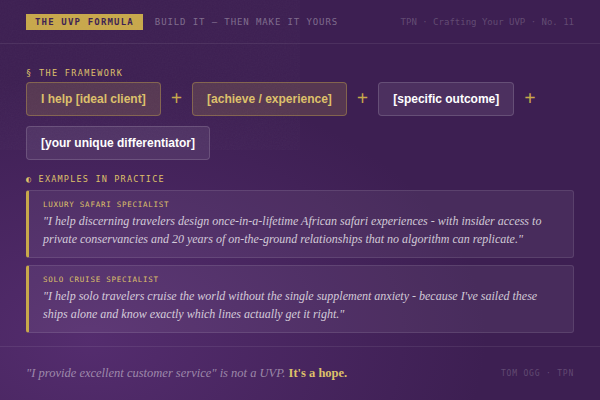
Start with this framework: I help [ideal client] [achieve / experience] [specific outcome] [your unique differentiator].
Applied to a luxury safari specialist: “I help discerning travelers design once-in-a-lifetime African safari experiences – with insider access to private conservancies and 20 years of on-the-ground relationships that no algorithm can replicate.”
Applied to a solo cruise specialist: “I help solo travelers cruise the world without the single supplement anxiety – because I’ve sailed these ships alone and know exactly which lines actually get it right.”
Notice what both examples do: they name a specific client, describe a specific outcome, and anchor the claim in something only a human with real experience can offer. That’s the formula working as intended.
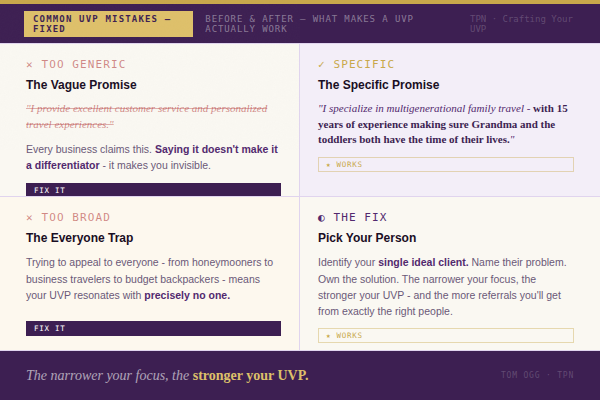
Common UVP Mistakes — And How to Fix Them
The Vague Promise:
“I provide excellent customer service and personalized travel experiences.” Every business claims this. Saying it doesn’t make it a differentiator – it makes you invisible. Fix it by getting specific: what does your service actually look like, and who is it specifically for?
The Everyone Trap:
Trying to appeal to everyone – from honeymooners to business travelers to budget backpackers – means your UVP resonates with precisely no one. Identify your single ideal client. Name their problem. Own the solution. The narrower your focus, the stronger your UVP – and the more referrals you’ll get from exactly the right people.
The Bottom Line
You’re fighting uphill while an AI rolls boulders at you. Your UVP is the shield, the differentiator, and the reason the right clients choose you over every algorithm that promises to do it faster. Craft it carefully. Deliver on it consistently. And remember: the ChatGPT plugin that built the Amalfi Coast itinerary in 11 seconds has never eaten bad paella in seventeen countries. You probably have. That experience is worth something. Make sure your UVP says so. To learn more about positioning your travel business for success in 2026, visit Travel Professional NEWS.