
The Commission Percentage Is the Headline. Everything Else Is What Actually Runs Your Business.
Presented by: Cruise Planners


Choosing how to start a travel business can look surprisingly simple when opportunities are presented as percentages: 70/30, 80/20, 90/10, 100% commission with monthly fees or a royalty-based model.
But those numbers do not tell you everything about the value or total cost of an opportunity.
One organization may offer a higher commission percentage but require advisors to purchase certain technology, marketing or training separately. Another may charge differently while providing a broader business system that includes technology, education, marketing resources and ongoing support.
That is why anyone researching how to choose a host agency or another supported business model should compare more than the percentage shown on a commission chart.
The better question is: What am I actually receiving in exchange for what I pay?
Host agencies and travel franchises can both provide paths into the travel industry, but they operate differently. Cruise Planners, for example, is a home-based travel franchise rather than a host agency. Neither model is automatically right for every advisor. The goal is to understand which structure best supports the business you want to build.

Cruise Planners franchise owners on a FAM trip with Travel Weekly and Debra Lee, Director, U.S., Canada and Cruise Niche, Travel Industry Sales.
Start With the Type of Travel Business You Want
Before comparing prices, commissions or fees, consider what kind of travel business you actually want.
Some advisors want to develop an independent agency around their own name, identity and systems. Others prefer to operate with an established national brand and existing business infrastructure.
Ask yourself:
- Do I want to develop a completely independent brand or operate with an established one?
- How much structure and business guidance do I want?
- Am I comfortable selecting and integrating my own systems?
- Am I primarily looking for booking and supplier access, or a more complete business platform?
- How much help will I need with marketing and business development?
Hosted advisors can absolutely own and operate independent travel agencies. The distinction is not about whether someone is a business owner. It is about differences in branding rights, contractual relationships, support structures and how closely an advisor’s business operates within a larger system.
Both paths can work. They simply appeal to different preferences and goals.
Compare the Entire Compensation Structure
Commission splits matter, but they should never be evaluated in isolation.
Host agencies may use commission splits, monthly fees, annual membership fees, startup charges, technology fees, marketing fees, transaction fees or a combination of these.
For example, under a hypothetical 80/20 travel advisor commission split, the advisor receives 80% of the supplier-paid commission while the host retains 20%. That is only an illustration. Host-agency structures vary widely.
Travel franchises may instead have an initial franchise investment, royalty fees, technology or administrative costs, marketing requirements, renewal fees or other contractual expenses.
Because the structures are different, comparing a commission split directly with a royalty percentage does not provide the full picture.
Questions to Ask About the Money Model
Before choosing a program, ask:
- What is the percentage calculated on?
- Does the percentage change as sales increase?
- Are there monthly or annual minimums?
- Which technology tools require additional payment?
- Are marketing resources included?
- Are there transaction, administrative or processing fees?
- Are training and support included?
- Are there renewal, transfer or exit costs?
The highest commission percentage or lowest advertised fee is not automatically the best value. Advisors need to understand exactly what they receive in exchange for what they pay.
Calculate the Cost of Building Missing Resources Yourself
One factor that rarely appears on a comparison chart is the cost of everything you may still need after joining.
Depending on what is included, an advisor could separately need CRM software, website development and hosting, email marketing software, social media tools, graphic design, accounting or commission tracking, training programs, sales coaching, marketing campaigns, lead-management systems or administrative support.
Those expenses can change the economics of what initially appears to be a low-cost program.
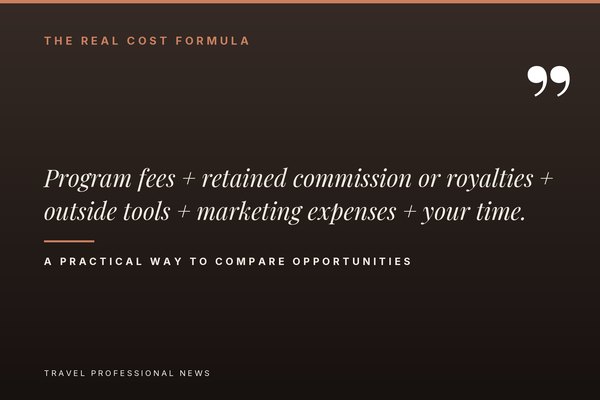
A useful way to think about the real cost is:
Program fees + retained commission or royalties + outside tools + marketing expenses + your time
This is not a formal financial formula. It is simply a practical reminder to calculate the cost of operating the entire business instead of comparing one advertised number.

Cruise Planners franchise owners at Star University in Fort Lauderdale, gaining hands-on training to launch and grow their travel businesses.
Examine the Training and Onboarding Experience
Supplier access gives an advisor the ability to sell travel. It does not automatically teach someone how to operate a travel business.
That distinction is particularly important for people trying to identify the best host agency for new travel agents or compare other beginner-friendly models.
New advisors may need education covering suppliers, booking procedures, client qualification, sales conversations, customer service, group travel, marketing, lead follow-up, commission tracking, business planning and industry standards.
Ask:
- Is training structured for beginners?
- Is it live, self-paced or both?
- Is there a defined onboarding process?
- Can advisors speak with an actual support person?
- Does training address sales and marketing as well as booking?
- Does education continue after launch?
- Is business-development coaching available?
Having access to a training library is valuable, but it is different from receiving a structured learning path that guides someone from onboarding through the early stages of building a business.
Look Beyond Booking Tools
Booking access is only one part of operating a successful travel agency.
Advisors also need systems for managing leads, organizing client information, tracking conversations, sending proposals, following up on inquiries, marketing to past clients, promoting supplier offers, encouraging repeat business and monitoring sales and commissions.
Technology Questions to Ask
When comparing systems, find out:
- Is a CRM included?
- Is a consumer-facing website provided?
- Are email campaigns available?
- Can marketing materials be customized?
- Are automation and follow-up tools included?
- Do the systems work together?
- Is technical support available?
- Will the technology continue to evolve?
Ideally, technology should reduce administrative work rather than create more of it, giving advisors more time to serve clients, develop relationships and generate sales.
Decide How Much Marketing Support You Need
New advisors sometimes focus heavily on supplier access while underestimating one of the biggest responsibilities of business ownership: finding and retaining clients.
Marketing support may include a professionally developed website, email campaigns, social media content, direct mail, promotional offers, brand templates, lead-capture tools, client segmentation, automated follow-up and local business-development guidance.
Pay attention to what “marketing support” actually includes.
Receiving generic marketing materials is different from receiving customizable campaigns. Having marketing tools available is also different from being taught how and when to use them.
One question can help clarify the distinction:
Does the organization only help me book travel, or does it also help me build a client base?
For someone starting a business from the ground up, that difference can significantly affect the overall value of the program.
Consider Brand Recognition and Creative Control
Branding is an important tradeoff to consider when comparing a host agency or travel franchise.
Building an independent brand can provide greater control over your business identity, positioning and messaging. It also means taking responsibility for developing that identity, creating marketing standards, building recognition and establishing credibility.
Operating with a franchise brand offers a different structure. Franchise owners may gain access to an established identity, existing marketing systems, brand resources and a potentially faster path to launching their business.
In exchange, franchise owners operate within an established system and follow brand requirements, which can mean less freedom to change certain aspects of the brand.
Neither approach is inherently better. The decision comes down to how much independence, recognition and structure you prefer.

Bianca Montalvo, SEO Marketing Manager; Angie Reyes, Social Media Strategist; and Ana Carolina Fenchak, Home Office Groups Manager — part of Cruise Planners’ 150+ Home Office team supporting franchise owners.
Evaluate Support After the Initial Launch
Strong onboarding is valuable, but advisors also need to understand what happens after the first few months.
Ongoing support might include continuing education, business coaching, technical support, supplier assistance, marketing guidance, peer communities, conferences, reporting tools or help resolving booking and commission issues.
Ask who you can contact when you need help and whether assistance is available by phone, email, chat or scheduled meetings. Find out whether support hours are clearly defined and whether coaching is proactive or only available when requested.
It is also worth asking whether support changes as the business grows. A new advisor may need very different guidance from an experienced advisor managing an established client base.
Think About the Business You Want Three Years From Now
Do not evaluate an opportunity only on how easy it is to make your first booking. Consider whether the model can support the business you eventually want to own.
Ask:
- Can the model support a growing book of business?
- Does the compensation structure improve as production increases?
- Can I add team members or associates?
- Who owns the client relationships and business data?
- Can the business be transferred or sold?
- What happens if I decide to leave?
- Are there renewal requirements?
- Will the technology and marketing support scale with the business?
- Is there support for specialties such as groups or luxury travel?
A model that works well during the first year may not necessarily provide everything an advisor needs three or five years later. Long-term fit should be part of the decision from the beginning.
A 10-Question Checklist for Comparing Your Options
Before choosing a travel agency business model, get clear answers to these 10 questions:
- 1. What business structure am I joining?
- 2. What are all the startup and recurring costs?
- 3. How are commissions, splits or royalties calculated?
- 4. What training is included for new advisors?
- 5. Which technology and client-management tools are provided?
- 6. What marketing resources are included?
- 7. How much control will I have over my brand?
- 8. What live support will be available after onboarding?
- 9. Who owns the client relationships and business data?
- 10.Can the model support my long-term growth plans?
Whenever possible, request the answers in writing. Review the complete agreement and applicable disclosure documents rather than basing a business decision solely on headline percentages or promotional claims.
Where Cruise Planners Fits into the Comparison
Cruise Planners is a home-based travel franchise, not a host agency. Franchise owners operate their own travel businesses with the support of the Cruise Planners system.
The model brings together structured training, technology, marketing resources, supplier relationships, business-development support and home-office assistance. Franchise owners also have access to ongoing travel advisor training and support designed to extend beyond the initial launch of the business.
Cruise Planners does not use a traditional host-agency commission split. Instead, its current franchise royalty model ranges from 3% down to 0% based on annual commissionable revenue. Prospective franchise owners should review the current Franchise Disclosure Document and current Cruise Planners terms for complete financial and contractual information.
A host agency may still be a strong option for someone who wants a different level of structure or more independence in creating an entirely separate brand.
Cruise Planners may be worth considering for someone who wants a recognized brand, structured training, integrated marketing and technology, business coaching and a supported path to building a long-term home-based travel business.
Choose Based on Total Value, Not One Number
Commission percentages and fees matter, but they are only one part of the decision.
A more meaningful comparison considers training, technology, marketing, branding, support, total costs and growth potential alongside the compensation structure.
Most importantly, think about the type of business you want to own.
For aspiring travel advisors who want to build a home-based business with training, technology, marketing resources and ongoing support, Cruise Planners offers a franchise model designed to provide more than booking access.
The right opportunity is ultimately the one whose complete business model aligns with what you want to build today and where you want that business to go in the future.
Choosing a Travel Business Model FAQs
Is a host agency the same as a travel franchise?
No. Both may provide supplier access, training and business resources, but the operating structure, branding, fees, agreements and support systems can differ.
Is the highest travel advisor commission split always better?
Not necessarily. Advisors should also consider monthly or annual fees, technology costs, marketing expenses, training, support and any business resources they may need to purchase separately.
Can someone become a travel advisor without experience?
Yes. Prior industry experience is not always required, but beginners should pay close attention to the quality of the training, onboarding, technology and ongoing support provided by the model they choose.
What should a new travel advisor compare first?
Start by comparing the complete business structure rather than a single percentage. Evaluate total costs, training, supplier access, marketing resources, technology, live support, branding and long-term growth opportunities.