

Four Paradigm Shifts Taught the Same Lesson. The Fifth One Is Teaching It Again.
Written By: Tom Ogg, Co-Founder and Co-Owner – Travel Professional NEWS

Every major shift in travel distribution arrived disguised as confusion. Agentic AI is no different, and the advisors who read the pattern early are the ones who will still be in business when the dust settles.
Nobody Sends a Memo
Here is something I have learned after more than fifty years in this business: a paradigm shift never introduces itself. Nobody calls a meeting. No supplier sends a memo announcing that the way you earn a living is about to change. What actually arrives is noise; conflicting headlines, nervous colleagues, a few loud predictions that the sky is falling, and a few louder ones insisting everything will be fine.
Only later, usually years later, does anyone look back and say, “Ah, that was the moment.”
I bring this up because we are standing in one of those moments right now. If you are feeling a little confused about artificial intelligence and what it means for your agency, congratulations; you are feeling exactly what every advisor felt at the start of every previous shift. Confusion is not a sign that you are behind. It is a sign that something real is happening.
A Short History of Getting Blindsided
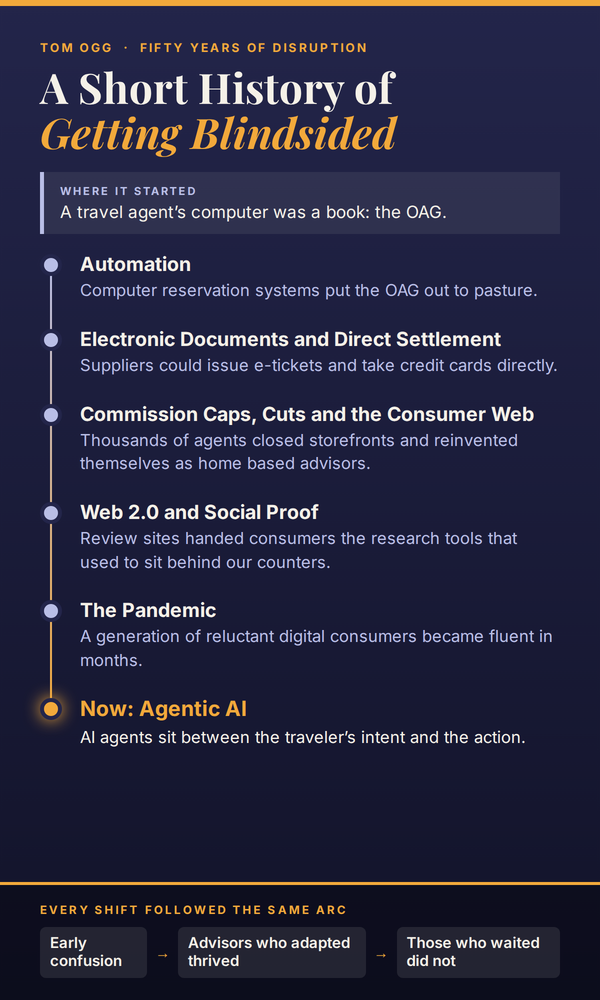
When I started, a travel agent’s computer was a book. The OAG sat on the desk, fat with schedules and fares, and booking a flight meant calling the airline’s agency desk, confirming by phone, running the ticket through a validation plate and handwriting the ticket. Vacations carried a “10 percent tax and service” line that was, in practice, the agent’s commission.
Think about what that agent was really selling. It was not advice, although good agents gave plenty of it. The agent’s economic role was documentation and settlement. The airlines, cruise lines and tour operators could not write tickets or collect money from consumers efficiently, so they paid us to do it. The only alternative for the traveler was standing in line at the airport.
Then the paradigms rolled in, one after another:
- Automation: Computer reservation systems put the OAG out to pasture, and inventory moved from books and phone calls to screens.
- Electronic Documents and Direct Settlement: Once suppliers could issue e-tickets and take credit cards directly, the original reason they needed us began to dissolve.
- Commission Caps, Cuts and the Consumer Web: This was the double punch that hurt most. Thousands of agents closed their storefronts, and a remarkable number of them reinvented themselves as home based advisors working with host agencies.
- Web 2.0 and Social Proof: Review sites and social platforms handed consumers the research tools that used to sit behind our counters. Simple, commodity transactions migrated online for good.
- The Pandemic: Practically overnight, people who had never trusted e-commerce were paying bills, attending meetings and chatting with bots online. A whole generation of reluctant digital consumers became fluent in a matter of months.
Every one of these shifts followed the same arc: early confusion, followed by a period where the advisors who adapted thrived and the ones who waited did not. The pattern is so consistent I would be tempted to call it a law, if I were the kind of person who called things laws.
The Fifth Paradigm Has a Name Now
A few years ago, I wrote that the industry was on the cusp of a huge change and admitted, honestly, that I had no idea what form it would take. I listed the ingredients I could see: smarter search, natural language chatbots, virtual assistants, direct settlement, social media and virtual reality. I sketched out a scenario in which a consumer would look at a resort online, chat with a virtual assistant, check dates, get a quote and confirm the booking without ever speaking to a human.
That Scenario Has a Name Now: Agentic AI.
The difference between the chatbots we grumbled about a few years ago and today’s AI agents is the difference between a brochure rack and a booking clerk. Generative AI produces content, while agentic AI is built to take actions on its own, booking, recommending, resolving questions and adjusting to context in real time. Industry voices are now arguing that the familiar travel funnel of search, compare, book and experience is starting to break down, with AI agents sitting between the traveler’s intent and the action, merging discovery, planning, booking and personalization into a single layer.
This is no longer theoretical. OpenAI opened ChatGPT to third party apps, with Expedia and Booking.com among the first travel brands on the platform, giving those companies access to a user base of roughly 800 million people. Travelers can pull up live flight and hotel data, compare prices and view maps without leaving the chat. The plumbing behind it matters too: the apps run on the Model Context Protocol, which lets the chatbot connect securely to outside tools and data.
Scoring My Own Crystal Ball
Since I put my predictions in print, it is only fair that I grade them.
What Held Up: Search really did become more definitive. The example I used years ago, a traveler looking for a transfer from a specific Barcelona hotel to a specific train station, is now a single conversational request that an AI assistant answers in seconds, often with booking options attached. Natural language processing and machine learning did turn chatbots from irritating menu trees into genuinely useful assistants. And the core of my imagined transaction, a consumer moving from research to quote to confirmation through a conversation with software, is happening.
What Did Not: Virtual reality and the metaverse were supposed to let travelers walk the halls of a resort before booking. VR still has a niche, and some suppliers use immersive video well, but it never became the front door to travel shopping. The headset stayed in the closet; the phone won.
What I Got Half Right: I predicted consumers would eventually hold a smart card up to the screen to pay. The actual answer turned out to be less theatrical and more effective: digital wallets, tap to pay and stored credentials. The settlement function I worried about did not just leave the agency; it practically disappeared into the device.
What Nobody Saw Coming: The assistant in my scenario belonged to the resort. In reality, the most important assistant belongs to the consumer. The traveler’s own AI, not the supplier’s chatbot, increasingly decides which brands even get considered. That is a far bigger shift than I imagined, and it cuts both ways for suppliers and advisors.
Not So Fast, Robot
Before anyone starts updating their résumé, look at what the agents are actually doing in the field. Skift’s hands-on testing found that travel apps inside AI chatbots can now return branded results, prices and booking buttons, but the user has to connect the app, and the chatbot has to recognize it is available and choose to use it. In those tests, even after Booking.com, Expedia and Viator were connected inside ChatGPT, the bot initially said it could not use them, and the apps only worked after extra prompting.
In other words, the robot is enthusiastic, articulate and occasionally forgets where it put its car keys. That will improve, quickly. But consumer trust is moving more slowly than the technology. In a Booking.com survey cited by L.E.K. Consulting, only 6% of consumers said they fully trust AI solutions with their travel, and 91% had at least one concern about using it. Research points the same direction from another angle: IMG’s 2026 survey found that likely AI users were most interested in recommendations, itinerary planning and inspiration, while booking ranked much lower.
That is the gap advisors live in. Consumers are happy to let AI dream with them. They are much less eager to let it spend $14,000 on a family river cruise without a human being in the loop.
The complex categories bear this out. According to PhocusWire, travel agents are expected to drive more than 70% of cruise bookings in 2026. Cruises, multigenerational trips, honeymoons, group travel and international itineraries with lots of moving parts are exactly where a mistake is expensive and where a human advisor earns the fee.
The Moat Moved, Again
Here is the lesson I wish someone had handed me in my first decade: every paradigm removes one reason clients need you and creates another.
Documentation and settlement used to be our moat. Technology drained it. What replaced it was expertise, relationships and problem solving; things that do not fit neatly into a reservation system. Agentic AI is now draining part of that moat as well, specifically the research and quoting work that used to fill an advisor’s afternoon. A client can get a decent first draft of an itinerary for free.
So What is Left, and What is New?
Judgment: AI can list fifteen Amalfi Coast hotels. It cannot tell you which one has the 140 stairs your client’s knee will not tolerate, or which property’s “sea view” is really a parking lot view with ambition.
Accountability: When a cruise itinerary changes or a connecting flight evaporates, an AI agent will offer options. An advisor will fight for the client. Recovery and rebooking are where loyalty is built, and they are still stubbornly human.
Curation in a World of Infinite Options: When everyone has access to unlimited information, the scarce commodity becomes a trusted filter. Advisors are no longer the source of information; we are the source of confidence.
Visibility to the Machines: This is the new one. If consumers increasingly start with an AI assistant, advisors need to be findable by AI, not just by Google. That means clear, specific, authoritative content about your niche, consistent business information online, and genuine reviews that an AI model will surface when someone asks for “a travel advisor who specializes in Alaska small ship cruises.”
Advisors Are Already Using the Same Weapons
The smartest advisors are not fighting AI; they are drafting behind it. TravelAge West data shows 35% of advisors now use AI daily and another 23% several times a week, a combined 58%, up from just 16% total usage in 2023. Here is how the practical side breaks down in a modern agency:
- Research and First Drafts: General assistants such as ChatGPT, Claude and Gemini, along with travel specific planners like Layla and GuideGeek, can produce a skeleton itinerary in minutes. The advisor’s job is to verify, customize and improve it. Never send an AI draft to a client unchecked; these tools still invent the occasional nonexistent ferry.
- Client Communication: CRM platforms now use AI to draft follow ups, summarize client histories and flag past travelers who are due for their next trip. A well configured chatbot on your website can answer basic questions at 2 a.m. and hand warm leads to you in the morning.
- Marketing: Social posts, email newsletters, destination blogs and video scripts can be drafted with AI and then edited into your own voice. The emphasis is on edited; clients can smell generic content from across the lobby.
- Market Intelligence: AI tools can summarize supplier announcements, compare competitor offers and spot trends in your niche far faster than any of us could with a stack of trade magazines.
- Fraud Protection: AI is a double edged sword here. Criminals use it to produce convincing phishing emails and fake supplier invoices, and payment providers use it to detect suspicious transactions. Verify any change in payment instructions by phone, every time.
So, How Do We Cash In?
I ended my original take on this subject with a question: how can we, as travel advisors, cash in on the coming paradigm? Now that the paradigm has arrived, here is my answer, and it is not complicated.
- Choose a niche narrow enough to be the best answer. AI rewards specificity. “Luxury travel” is a crowded room. “Accessible European river cruises for travelers with mobility challenges” is a room you can own.
- Make AI your research assistant, not your replacement. Let it handle the first 70% of the grunt work so you can spend your time on the 30% that requires a human.
- Charge for expertise. If AI makes information free, information cannot be what you sell. Planning fees reflect the value of judgment, access and accountability.
- Become visible to the assistants. Publish useful, specific content under your own name. Keep your business listings accurate. Collect reviews that describe what you actually do.
- Stay human where it counts. The phone call during a cancellation, the handwritten note after a honeymoon, the client who calls you first because they trust you: these are things no agent, artificial or otherwise, can manufacture.
The Pattern Holds
I have watched this industry survive the death of the OAG, the commission wars, the web, the OTAs, a pandemic and more predictions of the “end of the travel agent” than I can count. Each time, the advisors who recognized the pattern early, stopped resisting the obvious and repositioned themselves around what clients still needed, came out ahead.
The fifth paradigm will be no different. The tools are new. The confusion is familiar. And the opportunity, as always, belongs to the people willing to move first.