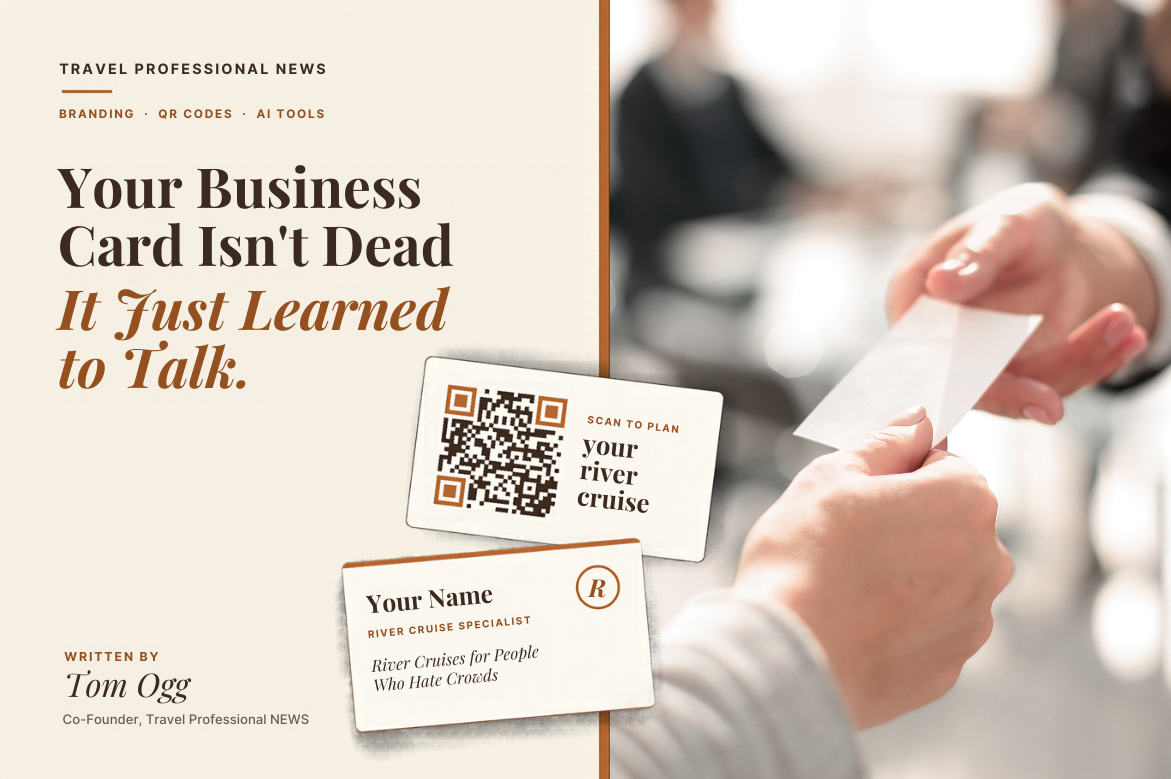
The Card That Decides in Three Seconds Whether a Prospect Keeps You or Tosses You. Make It Count.
Written By: Tom Ogg, Co-Founder and Co-Owner – Travel Professional NEWS

The little rectangle of card stock now carries a QR code, feeds an AI powered CRM and still decides in about three seconds whether a prospect keeps you or tosses you. Here is how travel advisors should design and use one today.
Not long ago I sat down with a shoebox of business cards collected at trade shows, fam trips and chamber mixers, intending to move the worthwhile contacts into my CRM. Two things jumped out. Some cards made that job easy and some made it miserable. And, more embarrassingly, I realized I had already decided which people I wanted to hear from again before I read a single phone number. The card had made the decision for me.
That exercise produced a list of dos and don’ts that has held up remarkably well. What has changed is everything around the card. Today I could point my phone at that shoebox, let an AI scanner read every card, fix the spelling of “Kissimmee” and drop the contacts into my CRM before my coffee got cold. The judgment about which cards were worth keeping, however, would still be mine.
That is the real story of the business card in 2026: the technology that handles the card has changed dramatically, while the human moment of handing one over matters more than ever.
Why the Card Survived the Smartphone
For the better part of fifteen years, technology pundits have predicted the death of the paper business card. First it was going to be replaced by Bluetooth contact swaps, then by LinkedIn, then by apps, then by digital cards you tap against someone’s phone. Every one of those tools exists, and some are quite good. Yet walk into any consortium conference or supplier event and you will still see advisors trading cards.
The reason is simple. A card is a physical object that outlives the moment. It sits on a desk, gets tucked into a wallet or ends up on a refrigerator next to the cruise line magnet. A digital contact disappears into a phone with 2,000 others. In a business built on relationships, that physical reminder still has value.
What has changed is the card’s job description. It used to be the entire message. Now it is a bridge between a face to face conversation and your digital presence: your website, your booking tools, your client portal and your follow up system.
Your Card Is Your Brand in Miniature
Remember the scene in American Psycho where a table of investment bankers nearly comes unglued comparing card stock and lettering? It was satire, but they understood something many travel advisors miss: the card is the first tangible piece of your brand most prospects will ever hold.
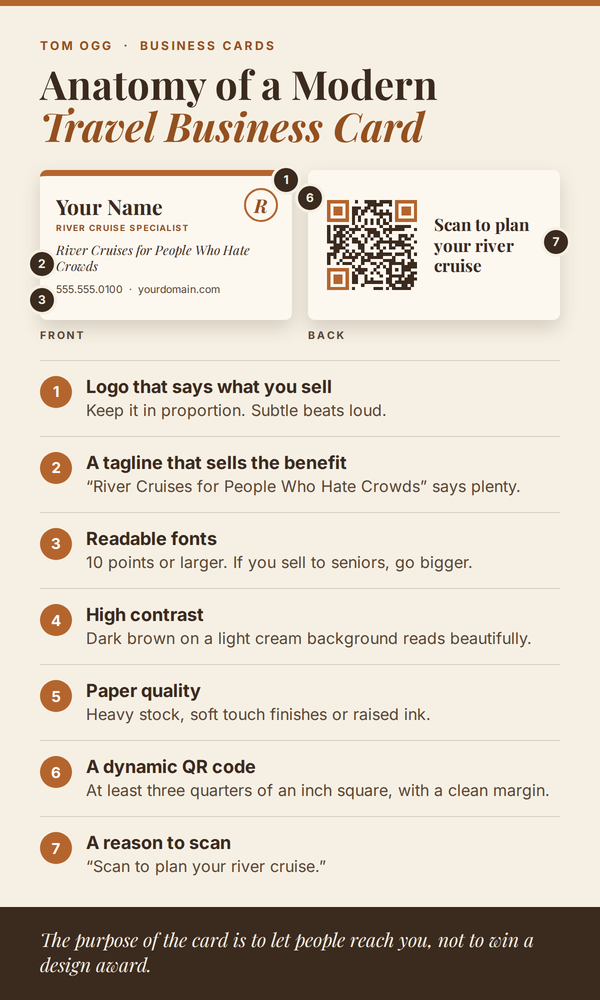
Start with a logo that says what you sell. A custom logo should reflect your niche or your unique value proposition (UVP), and it should appear everywhere: your card, your email signature, your social profiles and your website, until clients recognize it at a glance. Crowdsourcing sites such as 99designs and Crowdspring still work well for this. The newer option is AI design tools like Canva, Looka and Adobe Express, which can produce dozens of concepts in minutes for very little money.
A word of caution. AI generated logos are fine for brainstorming, but the U.S. Copyright Office has taken the position that material generated purely by AI, without meaningful human authorship, is not eligible for copyright protection. If you plan to trademark your logo or build a long term brand around it, use AI for inspiration and then have a human designer refine and own the final artwork. Also make sure your “original” concept is not suspiciously similar to someone else’s.
Keep the logo in proportion. It should support the card, not consume it. Subtle beats loud.
Write a tagline that sells the benefit. The tagline should tell a prospect exactly what you do and why they are better off booking with you. “Your Travel Specialist” says nothing. “River Cruises for People Who Hate Crowds” says plenty. This is where AI chat assistants like ChatGPT, Claude or Gemini earn their keep: ask for fifty tagline options aimed at your specific client profile, throw out forty five of them and polish the survivors. Then read the finalists aloud to a few real clients; the AI cannot tell you which one makes a retired couple from Scottsdale lean forward.
The Physical Details Still Matter
Some advice needs no AI update, because human hands and eyes have not changed.
Paper quality. A card on flimsy stock tells the recipient you were too cheap to buy better paper. All else being equal, the card printed on the nicest stock consistent with your brand wins every time. Weight and texture send a message before anyone reads a word. If you sell luxury, consider heavy stock, soft touch finishes or raised ink. Online printers now make these finishes affordable in small quantities, so there is little excuse for the paper equivalent of a paper towel.
Readable fonts. Choose clean, proven typefaces and keep text at 10 points or larger, using fonts designed to be read at that size. If you sell to seniors, go bigger. Nobody over 65 is going to dig out reading glasses to decode your script font; the card will go in the trash first. The purpose of the card is to let people reach you, not to win a design award.
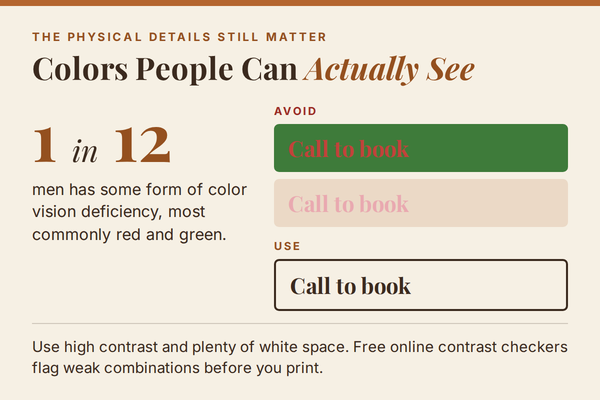
Colors people can actually see. Red text on a green background might look festive, but roughly 1 man in 12 has some form of color vision deficiency, most commonly red and green. Avoid low contrast combinations, especially reds, pinks, beiges and light greens printed over photographs. Use high contrast and plenty of white space on text heavy cards. Dark brown on a light cream background reads beautifully and feels upscale. Free online contrast checkers will flag weak combinations before you print 500 mistakes.
The QR Code: Your Card’s Back Door
When this advice was first written, QR codes were a curiosity that required a special app nobody had installed. That changed when Apple and Google built QR scanning into their phone cameras, and the pandemic finished the job by putting QR menus on every restaurant table. Today almost every prospect you meet can scan one without thinking.
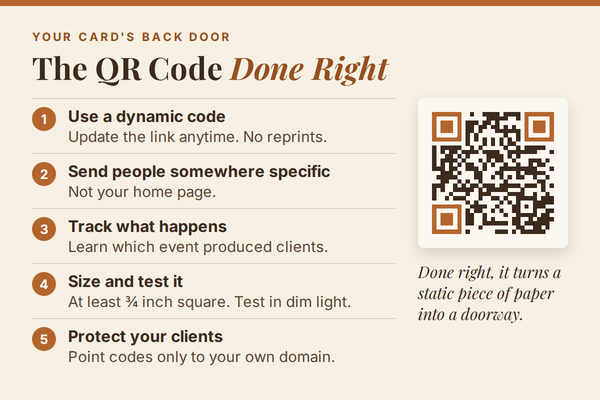
That makes the QR code the single most important addition to the modern travel business card. Done right, it turns a static piece of paper into a doorway. Done wrong, it is a pixelated decoration.
Use a dynamic code. A static QR code is baked in forever; if the link changes, your cards become scrap. A dynamic code, available from most QR generator services, points to a redirect you can update anytime. Next year’s website migration will not cost you a reprint.
Send people somewhere specific. Do not just link to your home page. Point the code to a page built for someone who just met you: a short welcome video, your specialty, a way to save your contact information and a simple “tell me about your next trip” form. Better still, have the page download your contact card (a vCard) straight into their phone, which solves the problem of your card getting lost in a coat pocket.
Track what happens. Dynamic codes and tracking parameters show you how many people scanned and when. Print different codes for a bridal show and a chamber mixer and you will learn which event actually produced clients rather than guessing.
Size and test it. Keep the code at least three quarters of an inch square with a clean margin around it, and test it on several phones in dim light before approving the proof. Add a few words such as “Scan to plan your river cruise” so people know why they should bother.
Protect your clients. Scammers have discovered QR codes too, and the FTC has warned consumers about fraudulent codes that lead to phishing sites. Use a reputable generator, point codes only to your own domain and tell clients you will never ask for payment information through a code on your card.
Digital Cards and NFC: A Complement, Not a Replacement
Digital card platforms such as HiHello, Popl and Blinq let you share your contact details with a tap or a scan, and NFC enabled cards push your information to a phone held close to them. Apple’s NameDrop feature even lets two iPhone users swap contacts by bringing their phones together.
These tools are useful, particularly with younger and tech savvy clients, and they never run out at the worst possible moment. My advice is to use both. Carry quality paper cards with a QR code, and keep a digital card ready on your phone. Let the prospect choose the format they prefer; meeting people where they are is the entire premise of good service.
Make the Card Work Harder Than Its Size
Standard cards are fine, but a card that unfolds is memorable. We have long used a trifold card as a mini brochure for our books: six panels of advertising that fold down to the size of a normal card. It produces orders on a regular basis.
If your niche is visual, consider a die cut card. An advisor who specializes in Regent Seven Seas Cruises might use a folded card with a die cut silhouette of one of the line’s ships on the cover. Nobody will wonder what that advisor sells. The QR code can live inside the fold, leading to current sailings or a video tour of the ship.
AI image tools can help here too, generating mockups of folded and die cut designs so you can see the concept before paying a printer. Just be sure any supplier logos or ship images you use are approved under that supplier’s marketing guidelines.
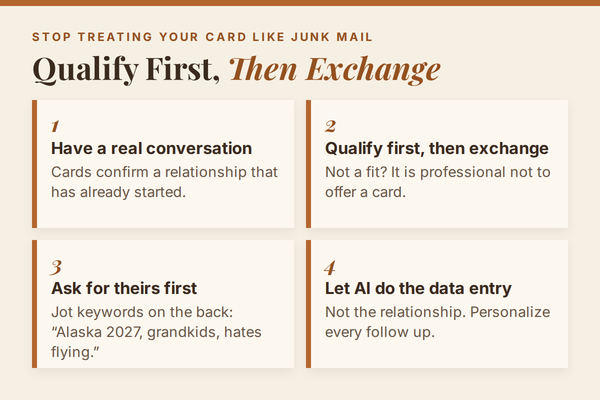
Stop Treating Your Card Like Junk Mail
Some marketing gurus still preach that you should hand cards to everyone you meet; one memorably suggested leaving stacks in the restrooms of office buildings where affluent people work. Think about how you treat the junk mail in your own mailbox. That is exactly how those cards are received.
If you want to reach thousands of people with your contact details, buy an ad or run a targeted social campaign; AI tools now make it easy to produce those campaigns and aim them at precise audiences. Your business card serves a different purpose: it confirms a relationship that has already started.
Qualify first, then exchange. The time to trade cards is after a real conversation, once you have decided this person fits your client profile and deserves a place in your CRM. If the conversation tells you they are not a fit, it is perfectly professional not to offer a card. You can graciously explain that you work with a particular type of traveler and that your outreach probably would not interest them.
Ask for theirs first. When a prospect does fit, ask for their card or contact information and whether you may follow up. Jot a few keywords on the back about what you discussed: “Alaska 2027, grandkids, hates flying.” If they then ask for your card, write a note on it that will remind them of your conversation.
Let AI do the data entry, not the relationship. This is where the old routine has improved the most. Card scanning apps and the scanners built into many CRMs capture a card in seconds. Some CRMs can now draft a personalized follow up email from your notes, schedule reminders and suggest the next touch. Use these tools; they eliminate the shoebox problem. But read and personalize every message before it goes out. Prospects spot generic AI text quickly, and a follow up that sounds like a robot wrote it undoes the goodwill of a great conversation.
Give Your Referral Program Its Own Card
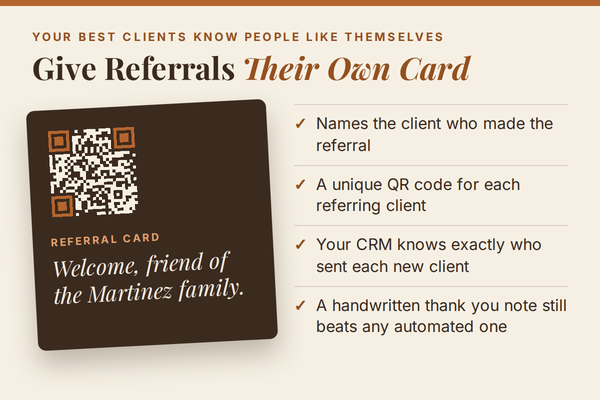
Your best clients know people just like themselves. A dedicated referral card gives them an easy way to pass you along: it names the client who made the referral and invites the new traveler to get in touch.
Technology makes this far more powerful than it once was. Give each referring client cards with a unique QR code that leads to a personalized landing page, such as “Welcome, friend of the Martinez family.” Your CRM will know exactly who sent each new client, so you can thank the referrer properly. And a handwritten thank you note still beats any automated one.
What Has Not Changed
For all the technology talk, the fundamentals remain stubbornly the same. A business card is a branding tool, a credibility signal and a reminder of a conversation. It should communicate your value proposition at a glance, it should be easy to read and it should go to people you actually want to hear from again.
AI and QR codes have not made the card obsolete; they have made it accountable. You can now see who scanned it, follow up in minutes instead of weeks and measure which events produce clients. Before you reorder another box of 500, decide what result you want from every card you hand over, and design it to deliver that result rather than copying what everyone else prints.