

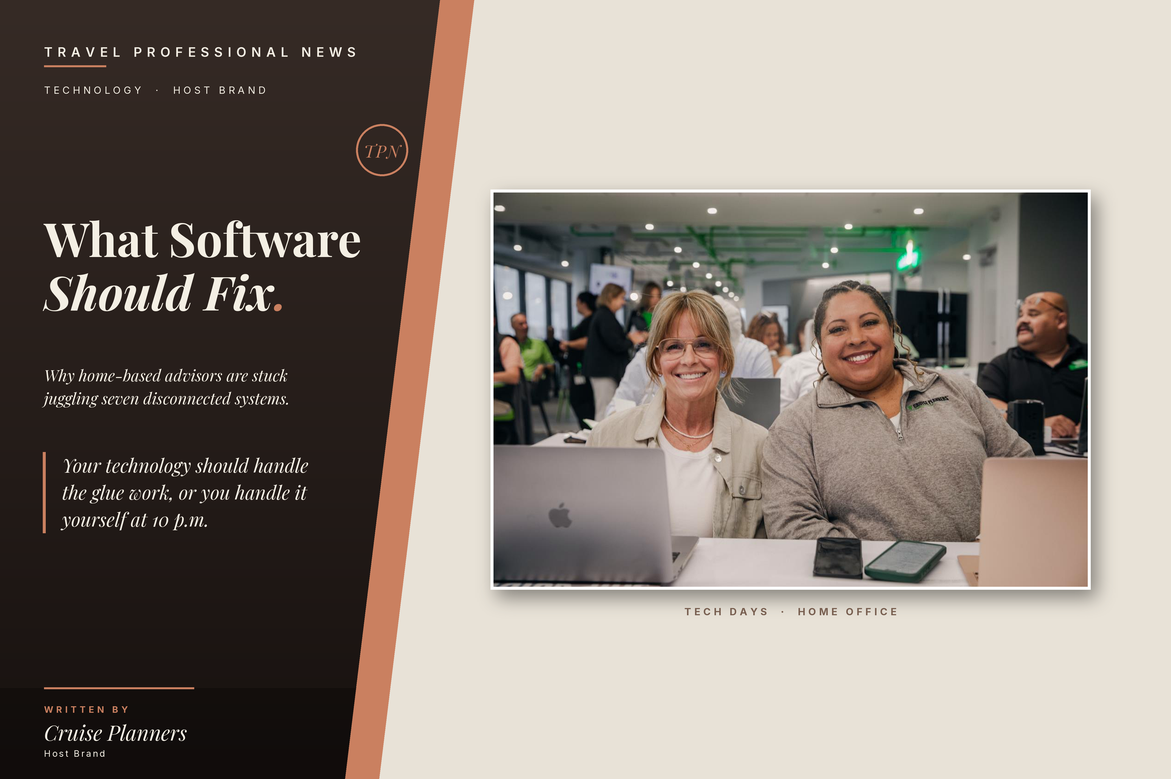
Seven Logins, Seven Problems — Why Fragmented Tech Is Quietly Costing You More Than You Think
Written By: Cruise Planners

Most home-based travel advisors are running their businesses across seven or more disconnected systems.
That number comes from a 2025 Sabre global survey of 499 agencies, which found that 91% operate on four or more booking platforms and more than half manage seven or more.

The result is exactly what you’d expect: slower response times, missed follow-ups, inconsistent client communication, and operational costs that keep rising without a clear return.
Cruise Planners sees this firsthand across its network of home-based franchise owners.
The problem isn’t a lack of available software. The problem is that too much of the available software was built for a different era, a different business model or a different kind of agency entirely.
The question worth asking is: What should modern travel agency software actually solve for home-based advisors, and how do you evaluate whether your current setup is helping you grow or quietly holding you back?
Why Are So Many Travel Advisors Still Paying for Tools That Don’t Talk to Each Other?
The Sabre survey found that more than 75% of agencies have added content connections in the past three years.
Rather than consolidating, they’re layering new systems on top of old ones. Nearly 90% manage four or more API integrations, and more than half said managing those connections has become a burden.
For home-based advisors, the math is especially painful.
You’re not a 200-person travel management company with an IT department. You’re one person, or part of a small team, trying to run CRM, email marketing, booking platforms, supplier portals, itinerary builders, and accounting from a home office.
Every tool that requires a separate login, a separate payment and a separate data-entry step is costing you time you could spend with clients.
The fragmentation also affects onboarding.
If you bring on a virtual assistant or family member to help during peak season, how long does it take to get them productive?
When the answer is “weeks, because the systems are complicated,” that’s a technology failure, not a people problem.

What Does a Home-Based Travel Advisor Actually Need from Their Software?
“Travel agency software” is a broad category, covering everything from GDS terminals to Instagram schedulers.
For a home-based advisor focused on growth, the core needs tend to fall into five areas.
Client Relationship Management
Client relationship management should store preferences, travel history, passport details, and communication logs in one searchable place.
Booking and Supplier Access
Booking and supplier access should let you search inventory, compare options and confirm reservations without toggling between six supplier portals.
Marketing Automation
Marketing automation should keep you visible to past clients and prospective leads without requiring you to manually schedule every email and social post.
Financial Tracking
Financial tracking should tell you what you’ve earned, what’s outstanding, and which commissions are due, connected to your actual bookings.
Mobile Access
Mobile access should let you respond to a client inquiry from anywhere, check a booking status or pull up trip details while you’re attending a supplier event.
The key distinction is that these five areas should connect to one another.
A booking confirmation should automatically update your CRM. A client’s anniversary should trigger a personalized email. A price drop on a watched sailing should surface in your dashboard without requiring you to check manually.
How Does Fragmented Technology Actually Cost a Home-Based Agency Money?
One of the clearest signals from the Sabre research is that more than 80% of agencies surveyed believe unified access through a single platform would reduce their technology costs.
That’s not a theoretical preference. That’s nearly the entire industry acknowledging a structural problem.
For a home-based advisor, the costs show up in three ways.
Direct Subscription Costs
Paying $50 per month for a CRM, $30 per month for email automation, $40 per month for an itinerary builder, $25 per month for a social media scheduler and $20 per month for accounting software adds up to nearly $2,000 per year before you’ve booked a single trip.
Time Costs
Every manual data transfer takes time.
Copying a booking confirmation into your CRM, re-entering client details into a supplier portal or updating a spreadsheet with commission totals may take only a few minutes. Those minutes compound across dozens of bookings.
A Sabre survey respondent at a travel management company in Argentina noted:
“Our clients expect a seamless experience. Fragmentation threatens that expectation, as it can lead to missing content, inconsistent information, and ultimately, a loss of trust.”
Opportunity Costs
When following up with a lead takes 15 minutes because you have to check three different systems to see their inquiry history; you follow up less often.
When creating a personalized proposal requires pulling data from four places, you send fewer proposals.
The revenue you don’t earn because the system slowed you down is invisible, but it’s real.
What Should You Look for When Evaluating Modern Travel Agency Software?
Start with integration depth, not feature count.
A platform that handles CRM, booking, marketing and financial tracking within one system will generally provide more value than a collection of “best-in-breed” tools that require you to be the connector between them.
Specific questions to ask during your evaluation include:
- Does the CRM automatically update when a booking is confirmed or modified?
- Can you search across clients, bookings, passport information and active leads from a single search bar?
- Does the marketing automation run without daily manual input from you?
- Can it support automated direct mail, scheduled social posts, and triggered email campaigns?
- Is there mobile access that gives you meaningful functionality, not just a simplified view?
- Do you pay separately for every tool, or is the technology included within a single business model?
- How much ongoing work will be required to connect and maintain the systems?
The last question matters more than many advisors realize.
The cost of technology isn’t limited to subscription fees. It also includes the time required to manage the connections between your tools.
How Is AI Changing What Travel Agency Software Can Do?
The Sabre survey found that 91% of agencies believe AI can enhance productivity and the customer experience.
At the same time, 41% remain concerned about AI’s implications for the workforce.
Both reactions make sense.
AI in travel technology is most useful when it eliminates repetitive tasks rather than replacing human judgment, destination knowledge and relationship-building skills.
For home-based advisors, practical AI applications include:
- Natural-language cruise searches
- AI-assisted content generation for marketing emails and social posts
- Automated monitoring for price drops and new itineraries
- Faster client communication
- Reservation summaries
- Intelligent lead scoring that helps prioritize follow-up
Natural-language cruise search, for example, allows an advisor to describe what a client wants and receive matching results without navigating complicated filter menus.
A request could be as simple as:
“Show seven-night Caribbean cruises in July with a balcony under $1,200.”
Cruise Planners’ Maxx Intelligence and AI Cruise Search tools are built around this philosophy.
Ask Maxx can help advisors draft personalized emails, brainstorm social content and answer operational questions. AI Cruise Search interprets natural-language requests and delivers relevant sailing results within seconds.
These tools are designed to make the advisor faster and more responsive, not to sit between the advisor and the client.
The key evaluation criterion is simple:
Does the AI reduce your manual work, or does it add another system you have to learn and manage?
If it’s the latter, it’s adding to the fragmentation problem rather than solving it.

What Separates a Modern Platform from a Collection of Modern Tools?
Fora Travel advisors have access to an AI assistant focused on research and productivity.
Dream Vacations has an AI-powered marketing suite.
While both important features, they are not part of a comprehensive AI strategy.
What distinguishes a platform from a collection of tools is whether the technology forms a single operating environment.
In a platform model, your CRM data informs your marketing automation, which connects to your booking activity, feeds your financial reporting, and surfaces through your mobile app.
You’re not exporting CSV files or manually syncing contacts between systems.
Cruise Planners’ CP Maxx platform was built specifically around this idea.
It functions as a central command center where client profiles, live inventory booking, custom quotes, triggered email communication, payment tracking, document management, and reporting dashboards live in one place.
The advisor’s mobile app connects to the same data, so managing a booking from a phone produces the same result as managing it from a desktop.
This is a meaningful distinction for home-based advisors because you don’t have an operations team to handle the glue work between systems.
Your technology either handles that integration for you, or you handle it yourself at 10 p.m. after your clients have gone to bed.
How Do You Know When You’ve Outgrown Your Current Tools?
A few diagnostic questions are worth asking yourself honestly:
- Are you spending more time managing your tools than serving your clients?
- Have you ever lost track of a lead because the information was in a system you forgot to check?
- Do you delay sending proposals because assembling the information takes too long?
- Have you avoided bringing on help because training someone on your systems would take weeks?
- Are you paying for multiple subscriptions that cover overlapping functions?
If you answered yes to two or more, your technology may be holding back your growth rather than supporting it.
The instinct for many advisors is to add another tool to solve a specific pain point.
But if the root problem is fragmentation, adding another tool only deepens it.
The alternative is evaluating whether a single integrated platform could replace several of your current subscriptions while reducing the manual work between them.
For many home-based advisors, that evaluation may reveal that the cost of switching is lower than the cost of staying where they are.
Modern Travel Technology Should Make the Business Easier to Run
Modernizing your travel business doesn’t have to mean doing more.
With the right system in place, it can mean working with fewer tools, completing fewer manual steps and spending more time focused on the reason you started the business in the first place: helping people plan trips they’ll remember.
Before adding another tool, ask:
- What specific problem will it solve?
- Will it connect with the systems I already use?
- What manual step will it eliminate?
- Will it replace an existing expense or create another one?
- How much time will it take to learn and maintain?
The right technology shouldn’t create more work for a home-based travel advisor.
It should help you respond faster, stay organized, serve clients more effectively, and build a business that can grow.
Explore an Integrated Technology Ecosystem for Travel Advisors
Cruise Planners includes its full technology ecosystem within its home-based travel franchise model, including CP Maxx, Maxx Intelligence, Ask Maxx, AI Cruise Search, mobile apps, automated marketing and supplier integrations.
The platform is designed to reduce disconnected systems and give franchise owners one central environment for managing clients, bookings, marketing, and business operations.
Explore the technology included with a Cruise Planners franchise.