
Does It Still Make Sense For a New Travel Agent to Work With a Host Agency in 2026?
Written By: Tom Ogg, Co-Founder and Co-Owner – Travel Professional NEWS
Let’s be honest. When the topic of host travel agencies comes up at industry cocktail parties — and yes, those still happen, though we now argue about AI prompts instead of GDS shortcuts — newer agents’ eyes occasionally glaze over. “Are they the best choice for a new agent?” they ask. The answer, dear reader, is a resounding yes. In 2026, working with a quality host travel agency might be more valuable than ever. And that’s not despite the artificial intelligence revolution reshaping our industry. It’s partly because of it.

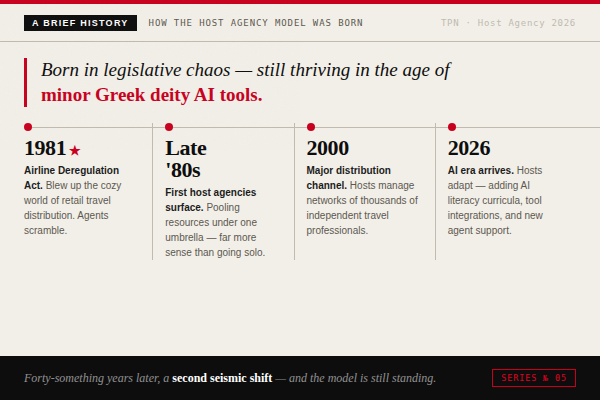
To understand why, it helps to appreciate how we got here. The host agency model was essentially born from legislative chaos. The Airline Deregulation Act of 1981 blew up the cozy old world of retail travel distribution, leaving agents scrambling to figure out how to keep their businesses alive without maintaining expensive brick-and-mortar storefronts and their own ARC appointments. Clever entrepreneurs figured out that pooling resources under a single umbrella made far more sense, and the host agency model was born. The first host agencies surfaced in the late 1980s; by 2000, they were a major distribution channel. Today, some host agencies manage networks of thousands of independent travel professionals and are genuinely sophisticated enterprises.
Fast forward forty-something years, and we’re experiencing another seismic industry shift — this time driven not by Congress, but by large language models, autonomous booking agents, and AI-powered trip-planning tools with names that sound like minor Greek deities. So the question on every independent agent’s lips is: does the host agency model still hold up? Or should you just let a chatbot handle everything while you sip a mai tai on a fam trip you booked yourself?
Here’s the not-very-surprising conclusion from someone who’s been watching this industry longer than Google has existed: the host agency model has not only survived, it’s adapting with remarkable agility. And if you’re a newer agent trying to launch a travel business in 2026, bypassing a quality host agency is a bit like refusing to use a GPS because you “prefer to figure things out.” Noble, perhaps. Efficient, definitely not.
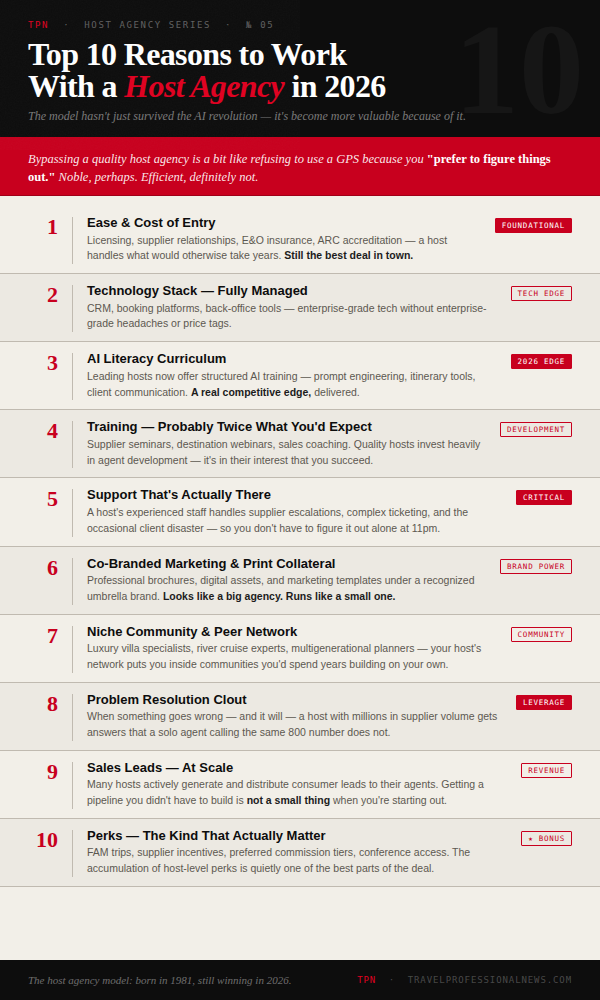
The Top 10 Reasons to Work With a Host Travel Agency in 2026
1. Ease and Cost of Entry (Still the Best Deal in Town)
Starting a travel business from scratch remains a daunting undertaking. There are licensing considerations, supplier relationships to establish, technology platforms to evaluate, E&O insurance to acquire, and ARC accreditation to navigate — and that’s before you’ve sold a single trip. A quality host agency handles all of this under one umbrella, dramatically lowering the barrier to entry for new agents. The economics of joining a host versus going fully independent remain heavily in the host’s favor, particularly in the early years when cash flow is tight and every dollar spent on overhead is a dollar not spent on building your client base.
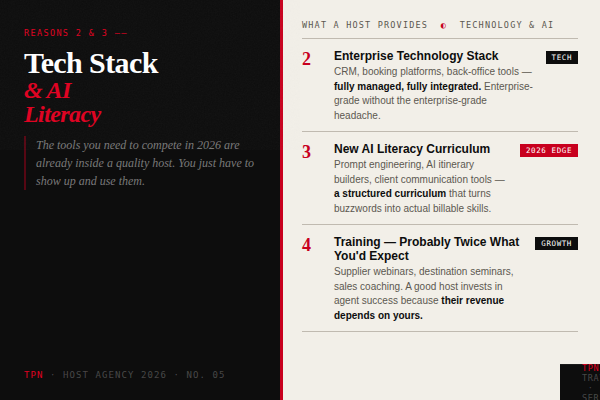
2. Technology — Full Stack, Fully Managed
The technology landscape for travel agents has never been more capable — or more overwhelming. CRM systems, booking platforms, back-office tools, client communication suites — evaluating, procuring, integrating, and maintaining all of these independently is a part-time job in itself. Quality host agencies provide enterprise-grade technology platforms as part of their offering, fully managed and regularly updated. You get the tools you need to run a professional operation without the headache of being your own IT department.
3. AI Literacy — A New Curriculum, a Real Edge
This is the one that has changed most dramatically since our last look at the host agency model. Leading host agencies in 2026 are now actively developing and delivering AI literacy curricula for their agent networks — structured training in prompt engineering, AI itinerary building tools, client communication automation, and more. For new agents, this is a meaningful competitive advantage. Learning to use these tools effectively, inside a supported environment with peers who are figuring it out alongside you, is a very different proposition from trying to self-educate in isolation.
4. Training — Probably Twice What You’d Expect
Beyond AI, the breadth of training available through quality host agencies remains one of the model’s most underappreciated benefits. Supplier seminars, destination webinars, sales coaching, business development workshops — a good host invests heavily in agent training because their revenue is directly tied to their agents’ success. This alignment of incentives produces a training environment that is genuinely motivated to make you better at your job.
5. Support — That’s Actually There When You Need It
One of the realities of building a solo travel business is that you will, at some point, encounter a situation you’ve never seen before — a client stranded mid-trip, a supplier dispute that requires escalation, a booking error that needs untangling at 10pm on a Friday. A host agency with experienced operations staff and established supplier relationships is equipped to handle these situations in ways that a solo agent simply isn’t. That support — reliably available, genuinely knowledgeable — is worth a great deal and is consistently undervalued by newer agents evaluating whether to join a host.
6. Co-Branded Marketing and Print Collateral
Professional presentation matters, especially early in a career when you’re still building credibility. Quality host agencies provide co-branded marketing materials — professional brochures, digital assets, social media templates — that allow new agents to present themselves with the polish of an established agency from day one. Looks like a big agency. Runs like a nimble, personalized one. That combination is hard to achieve independently.
7. Niche Community and Peer Network
The community dimension of a host agency is one of its least-marketed and most genuinely valuable features. Inside a quality host’s network, you’ll find luxury villa specialists, river cruise aficionados, multigenerational travel planners, adventure travel experts — peer communities that would take years to build organically on your own. Access to those peers, their accumulated knowledge, and their supplier relationships accelerates your development in ways that are difficult to quantify but impossible to overstate.
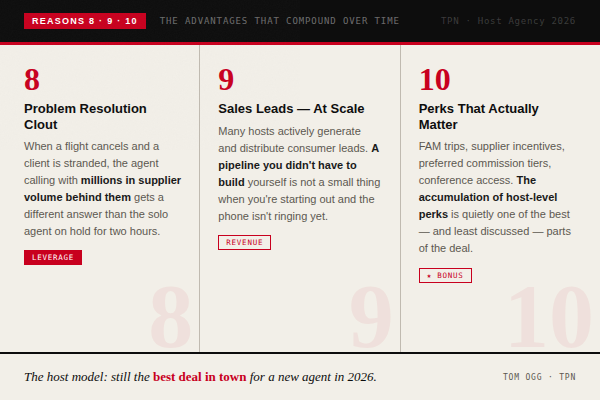
8. Problem Resolution Clout
When something goes wrong — and in travel, something always eventually goes wrong — a host agency with millions of dollars in supplier volume behind it gets a different level of attention than a solo agent calling the same 800 number. That clout translates into faster resolutions, better outcomes for clients, and less time you spend on hold explaining the situation for the third time to a different representative. It’s a quiet advantage that only becomes visible in a crisis, which is exactly when you need it most.
9. Sales Leads — Because They Have the Scale
Many host agencies actively generate and distribute consumer leads to their agent networks. Getting a pipeline you didn’t have to build is not a small thing when you’re starting out and the phone isn’t ringing yet. The lead generation capabilities of a well-run host — through their website, supplier partnerships, and marketing programs — represent genuine revenue that a new agent would otherwise have to develop from scratch.
10. Perks — The Kind That Actually Matter
FAM trips, supplier incentives, preferred commission tiers, industry conference access — the accumulation of host-level perks is quietly one of the best and least-discussed parts of the deal. Individually, each perk may seem modest. Collectively, over the course of a year, they represent a meaningful professional and financial benefit that solo agents either forgo entirely or access only partially.
The Bottom Line
The host agency model was born in legislative chaos in 1981, grew into a major distribution channel by 2000, and is now navigating the AI era with more sophistication than its critics anticipated. For a new agent in 2026, the case for working with a quality host agency remains overwhelming — not because the landscape hasn’t changed, but because quality host agencies have changed with it.
The question was never really whether host agencies would survive the AI revolution. The real question is whether new agents will be smart enough to use every available advantage when building their businesses — and a quality host agency remains one of the most significant advantages available. To explore host agency options and find the right fit for your new travel agent business, visit Travel Professional NEWS.