

How 3–8 minutes of intentional storytelling can build trust, showcase expertise, and move viewers confidently toward booking.
Written By: Tom Ogg, Co-Founder and Co-Owner – Travel Professional NEWS

Let’s talk about long-form video, basically any video longer than the average human attention span on social media, which science tells us hovers somewhere between a goldfish’s memory and the time it takes your teenage nephew to respond to a text message (approximately 5 to 90 seconds).
Here’s the Concept

If a TikTok is a shot of espresso, a long-form video is sitting down for a leisurely three-course meal with wine pairings and that little palate cleanser sorbet between courses.
We’re talking videos that clock in at 8+ minutes, though many ambitious souls stretch them to 30-minutes, an hour, or even longer. These are the videos where creators actually have time to, you know, finish their sentences without cutting to a trending dance move.
Long-form video is basically the antidote to our goldfish-brain internet culture. It says, “Hey, some things actually require more than 90-seconds to explain properly”, like why your clients absolutely need travel insurance, or why that “beachfront” hotel is technically beachfront if you consider a six-lane highway part of the natural coastal ecosystem.
The Many Personalities of Long-Form Video (Like Dogs, But Digital)
Like dogs and wine varieties, long-form video comes in numerous personalities. You’ve got training videos, courses, tutorials, lectures, webinars, keynotes, explainers, case studies, conference recaps, panel discussions and workshop presentations.
There are more marketing video personalities than there are cruise ship buffet jokes. Product demonstrations, cruise ship tours, resort walkthroughs, destination guides, train journeys, ski resort showcases, educational content, customer support compilations, FAQ videos… the list is longer than the line for the waterslide on embarkation day.
All of these long-form videos could run up to more than an hour. And I’m absolutely certain that you’ll find a need for one or more of these video types in your future, probably right around the time a client asks, “But what’s the difference between a balcony and a veranda?”
The Long-Form Travel Marketing Video: Your Conversion Champion

However, this article is about a very specific type of long-form video. A long-form travel marketing video should be between 3-8 minutes in duration and act as the intermediary between your short-form video and your landing page where the sale gets consummated.
Think of the flow like this: your short-form video is the “reach,” the long-form video is “the converter,” and your landing page is the “deal closer.”
Long-form marketing videos aren’t radically different from short-form videos, you just have considerably more time to add value to your unique proposition. And this is where branding becomes critically important. The last thing you want is to end up like some spectacularly tone-deaf campaigns that shall remain mostly nameless (okay, fine: Budweiser’s Dylan Mulvaney disaster, United’s “Fly the Friendly Skies” debacle, Visit Denmark’s “Do It for Denmark” awkwardness, and Malaysia Airlines’ ill-timed “Bucket List” campaign). Learn from their pain.
Your long-form video should replicate your short-form video in every conceivable way. In fact, they should be so seamless that viewers don’t even realize they’ve transitioned, like a well-executed magic trick, but with fewer rabbits and more resort amenities.
Remember: your short-form video is simply the “hook” to entice viewers to continue their exploration by watching your long-form video for additional information. Use the same colors, fonts, audio, and theme throughout your entire conversion funnel so that moving from short-form to long-form is absolutely seamless. Ditto for the transition from your long-form video to your landing page. Consistency is key, like always ordering the same drink at the resort bar so the bartender remembers you by day three.
5 Elements of a Successful Long-Form Video
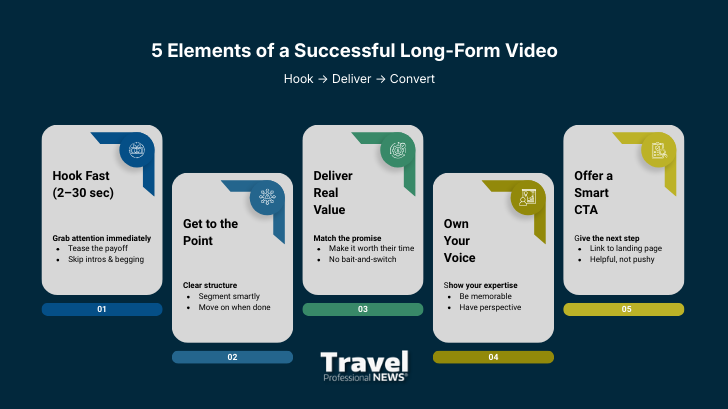
Like short-form videos, long-form videos face similar challenges and opportunities. Here’s what you need:
1. A Strong Hook in the First 2-30 Seconds
You need to immediately grab attention and make viewers curious about what’s coming. This could be a compelling question, a surprising statement, or a preview of the payoff they’ll get by watching. Unlike short-form videos, which give you a merciless 1 to 3 seconds to set the hook, long-form videos grant you more time. But set the hook as quickly as possible and then proceed to converting the sale.
Here’s what will immediately cost you a sale:
- “Like and Subscribe” requests (nobody cares)
- “Follow and Ring the Bell” begging (still nobody cares)
- Your “Company Introduction Video” (definitely nobody cares)
- Your selfie stick (please, for the love of all that is holy, nobody cares)
2. Get to the Point
Long-form content needs intentional organization so viewers don’t get lost or bored, or worse, both simultaneously. This means thoughtful segments laid out in logical and engaging formats, with variation in energy levels and strategic placement of key moments to maintain momentum throughout. Make your point and then move on to the next.
3. Offer Genuine Value or Payoff
Whether you’re showcasing a cruise, an all-inclusive resort, a boutique hotel, or another travel experience, viewers need to feel their time investment was worthwhile. The content should deliver on whatever promise you made in your hook and title. This will encourage the viewer to take the next step. Bait-and-switch might work for Vegas magic shows, but it’ll tank your conversion rate faster than a cruise ship WiFi connection.
4. Authentic Personality or Perspective
What makes your take on this topic different? Long-form gives you space to showcase your unique voice, expertise, or storytelling style that keeps people engaged with you specifically, not just the topic. Are you the luxury travel guru? The budget hack master? The family vacation whisperer? Own it. Lean into it. Be memorable.
5. Have an Effective CTA (Call to Action)
Once your visitor has viewed your long-form video, they’ve probably made a “go/no-go” decision. You should present them with the next opportunity to discover more by offering a link to your landing page. Again, this link should be an offer of help, not a hard sales pitch that feels like a timeshare presentation. Nobody likes those.
Why Long-Form Video Actually Matters (Besides Giving You Something to Do)
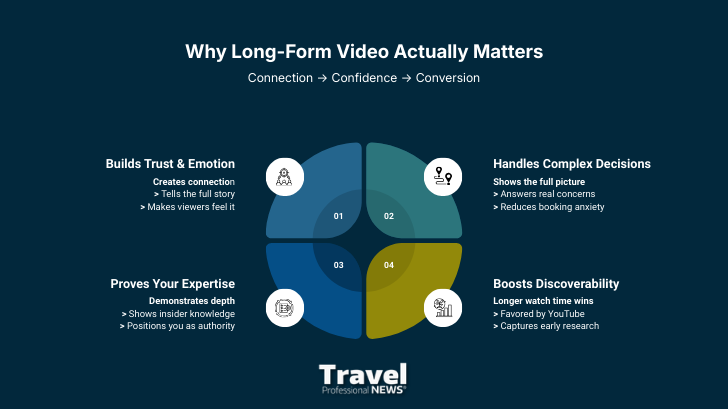
Long-form video is crucial in the travel conversion funnel for several compelling reasons:
Building Emotional Connection and Trust
Travel is an expensive, high-consideration purchase where people are investing significant money and precious vacation time—often their only real time off all year. Long-form video (typically 3-8+ minutes) gives you the time to tell a complete story that helps viewers emotionally connect with a destination.
When someone can watch an 8-minute video showing the authentic experience of walking through a Moroccan souk, staying at a boutique hotel, or exploring hidden beaches in Thailand, they’re mentally placing themselves in that experience. This emotional investment is what drives booking decisions. They’re not just seeing a beach; they’re imagining themselves on that specific lounger, with that specific cocktail, achieving that specific level of relaxation they haven’t felt since 2019.
Addressing Complex Decision-Making Needs
Unlike buying a T-shirt online (which, let’s be honest, we’ve all done at 2 AM while scrolling), booking travel involves weighing dozens of variables: accommodation quality, location safety, food options, activities, transportation, weather timing, budget allocation, whether the hotel photos are “creative angles” or actual representations…
Long-form content lets you comprehensively address these concerns in one place. You can show the hotel room and the neighborhood and the nearby restaurants and the day trip options, giving viewers the complete picture they need to feel confident booking. It’s like a comprehensive pre-trip reconnaissance mission, but without the expense of actually going there first.
Demonstrating Expertise and Authority
An 8+-minute destination guide or itinerary breakdown signals that you truly know this place. It positions you as someone who’s done the homework, understands the nuances (like which beach gets overcrowded by noon, or which restaurant requires reservations three weeks in advance), and can be trusted to plan their trip. This is especially important for travel agents competing against the infinite void of internet “experts” who visited once on spring break and now have opinions.
SEO and Discoverability
YouTube heavily favors longer watch times in its algorithm. An 8-minute video that keeps viewers engaged will get significantly more reach than a 60-second clip. Since many travelers start their research on YouTube (searching things like “best things to do in Lisbon” or “is Cabo really worth it”), long-form content helps you capture people early in their journey, ideally before they’ve committed to inferior options or, heaven forbid, tried to plan everything themselves.
The Bottom Line
The key is understanding that travel selling isn’t about quick impulse buys like those socks you added to your Amazon cart at midnight. It’s about building enough confidence and desire that someone will commit thousands of dollars and irreplaceable time off. Long-form video uniquely provides the depth and immersion needed to make that happen.
So grab your camera, polish your script, and start creating content that actually gives your viewers something worth watching. Your conversion rate—and your commission checks—will thank you.