
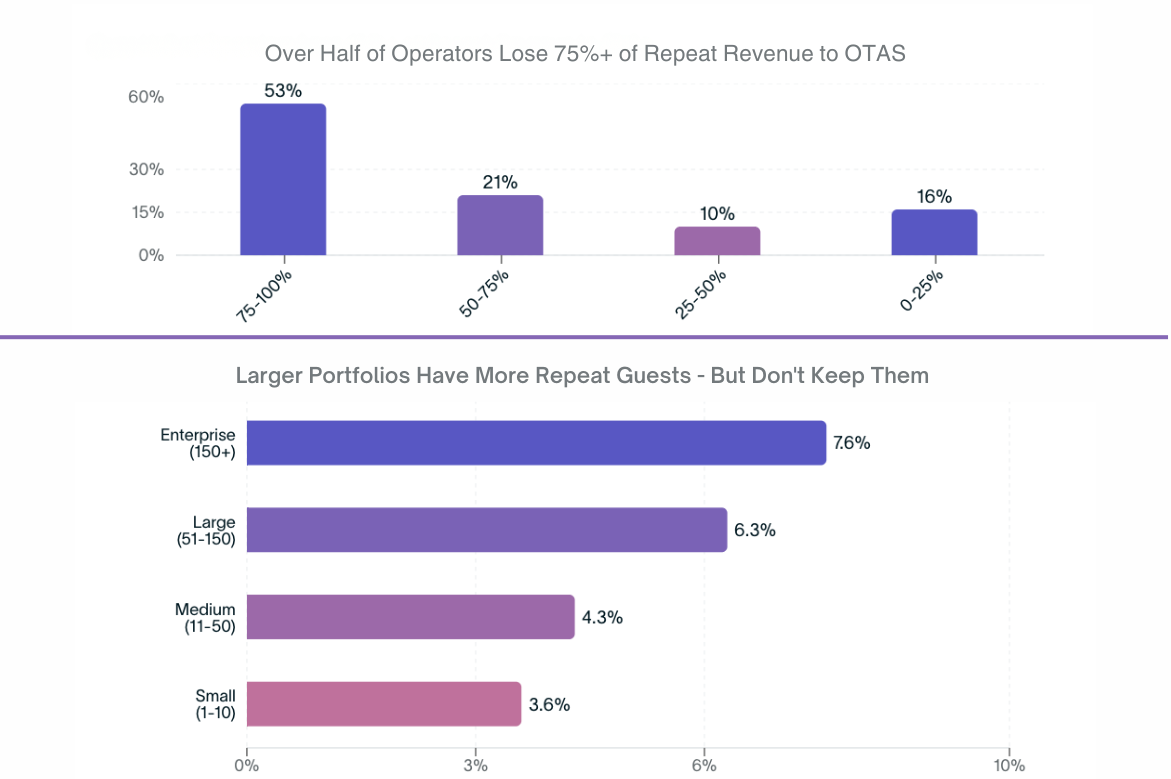
A hostAI study of 230,000+ bookings from 115 operators worldwide reveals major repeat-guest leakage, with 77% of repeat revenue still going through OTAs—costing operators 12–20% in commissions.
San Francisco, 20 January, 2026 – A new study led by hostAI, an artificial intelligence–based software company specializing in direct distribution for vacation rental operators, reveals that short-term rental operators spend over $1 billion annually in commissions to online travel agencies (OTAs) for guests who have already stayed with them. The analysis, based on a sample of 230,000 bookings from 115 operators worldwide, finds that the vast majority of revenue generated by repeat guests flows through platforms such as Airbnb, VRBO, and Booking.com, highlighting a significant opportunity to increase profitability through direct booking strategies.

hostAI calls this phenomenon “repeat guest leakage,” a structural issue that shows how, while operators work to build customer loyalty, much of that revenue automatically ends up with OTAs, reducing the profitability of their most valuable guests.
According to the study, repeat guests account for between 1% and 26% of total booking revenue, with a median of 5%. About 77% of that revenue flows back through OTAs, meaning operators pay commissions of 12% to 20% on customers they have already acquired. Leakage decreases significantly as operators strengthen their direct booking channels, with operators recording less than 5% of direct bookings losing up to 87% of repeat guest revenue, while those with more than 30% direct bookings limit that loss to just 10%.
“Most short-term rental operators do not know how many of their guests are repeat customers or why they return to OTAs,” explains Amirali Mohajer, CEO and founder of hostAI. And adds that investing in direct bookings “not only reduces costs but also builds much stronger long-term loyalty. Data from hostAI’s platform shows that guests who book directly return 28.3% of the time, compared with only 8.9% through Airbnb, meaning that direct bookings generate three times more repeat guests than OTAs,”.
The channel through which a guest makes their first booking proves decisive.
Approximately 86% of guests who booked directly returned via the same channel, while nearly 89% of those who discovered a property on Airbnb rebooked on that platform. This pattern demonstrates that building direct relationships with guests and maintaining post-stay communication creates a multiplier effect on loyalty and future profitability.
The study also highlights that operator size affects revenue leakage. Larger portfolios generate more repeat guests but also lose a higher proportion of that revenue to OTAs, whereas smaller operators are better able to retain their loyal customers.
“One notable example is a luxury operator in Florida, which, despite only 15% of its bookings being direct, saw those direct bookings account for 84% of repeat guest revenue. Their success relied on direct acquisition strategies through paid advertising and systematic post-stay email campaigns, rather than depending solely on OTAs,” Mohajer concludes.
According to hostAI, a major challenge is that repeat guests continue to book through OTAs because they remember the property but not the operator, lack incentives to book directly, and perceive OTAs as safer and more familiar. To reverse this trend, the company recommends reinforcing brand identity throughout the guest journey, offering exclusive benefits for direct bookings, measuring the true cost of OTA leakage, investing in direct guest acquisition, and maintaining constant communication with past guests.
The hostAI study is based on 231,150 confirmed bookings from 2025, covering operators with between 1 and 588 properties and annual booking values ranging from $31,000 to $15 million, using fully anonymized data from hostAI’s analytics platform.
Find the full study here: : https://gethostai.com/reports/repeat-guest-benchmark?sid=ses_mkelojgo